Telegraphing attacks: how to warn players before a hit
A telegraphed attack warns you where and when it will land. How Mytheria telegraphs every attack: a shape on the ground, a clock, more time for big hits.
On this page
- What is a telegraphed attack?
- The short answer
- Show the shape of the hit on the ground
- Show the timing with a clock
- The bigger the hit, the longer the warning
- Make the warning readable on any ground
- One colour language for every enemy
- Don't rely on colour alone
- Give players a way out
- A checklist for telegraphing attacks
Getting hit by something you never saw coming feels unfair, however fair the numbers are. In Mytheria, our pixel-art co-op game, every enemy attack is announced before it lands, so when you get hit, you know it was your mistake and what to do next time.
Every clip below is from the game, and every number comes from the game's own creature data.
What is a telegraphed attack?
A telegraphed attack is one that warns the player before it lands: where it will hit, and when. Telegraphing is that warning, whether it's a wind-up pose, a sound or a shape drawn on the ground. A good telegraph tells you in a split second where it's safe to stand and how long you have to get there.
The short answer
This is how Mytheria telegraphs every enemy attack:
- The warning on the ground has the same shape and size as the hit itself, for example a lane for a charge or a ring for a pulse.
- A line or arc fills the shape as the hit gets closer, like a clock.
- Bigger hits warn for longer: a 5-damage snap warns for 0.42 seconds, and a 30-damage boss quake for 3 seconds.
- The creature also winds up in a pose you learn to read before you look at the ground.
- A dark edge keeps every warning readable on grass, sand and snow, and at night.
- Every enemy uses the same colours: red means dodge, and blue means you can counter.
Show the shape of the hit on the ground
Every attack in Mytheria commits to an exact area before it starts, and that area is drawn on the ground during the windup. The warning is drawn from the same numbers the game uses to decide whether you get hit, so if you're outside the shape, you're safe.
These three creatures each warn with a different shape. Try them at half speed too.
Choose an attack to see how it warns you
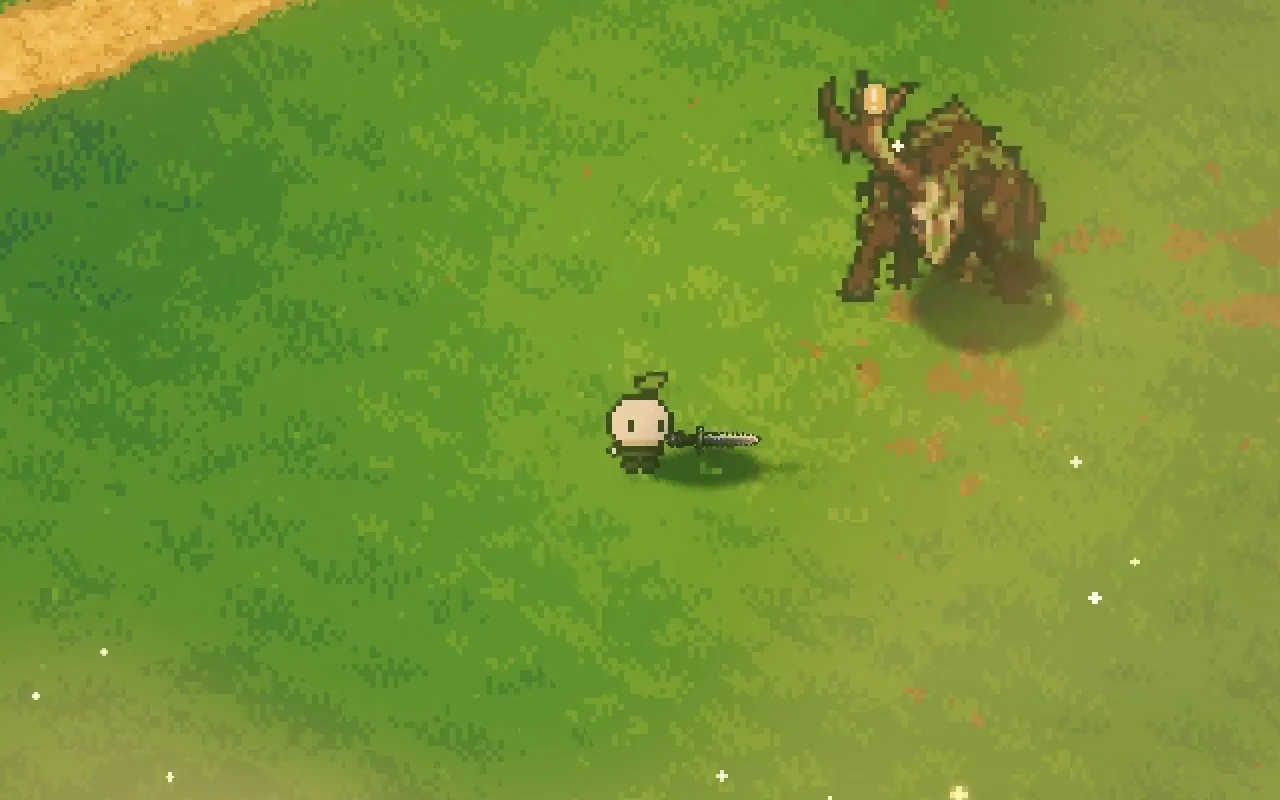
The Hollowhorn's charge: a lane toward you, 1.15 seconds of warning and 15 damage. Step out of the lane.
Show the timing with a clock
The shape shows where the hit will land, and a clock shows when: a white line runs along a charge lane, and an arc sweeps around a fan or a ring. When it's full, the hit lands. On a long charge lane the colour also fills from the creature toward the far end as the hit gets closer.
The bigger the hit, the longer the warning
Our rule of thumb is that the harder an attack hits, the more time you get to see it coming. Quick, small attacks can be nearly instant, because getting caught by one costs little. The Stoneback Colossus's quake does 30 of your 60 health, so it warns for 3 seconds.
Hover or tap a dot.
Hover, tap or tab to a dot to see which attack it is
Regular creatures Elites and bosses
A few attacks break the rule of thumb: the Hush Owl's swoop warns for 1.1 seconds but only does 5 damage. Most sit on the line, from the Flintmite's snap at 0.42 seconds up to the Stoneback Colossus's quake at 3 seconds.
Make the warning readable on any ground
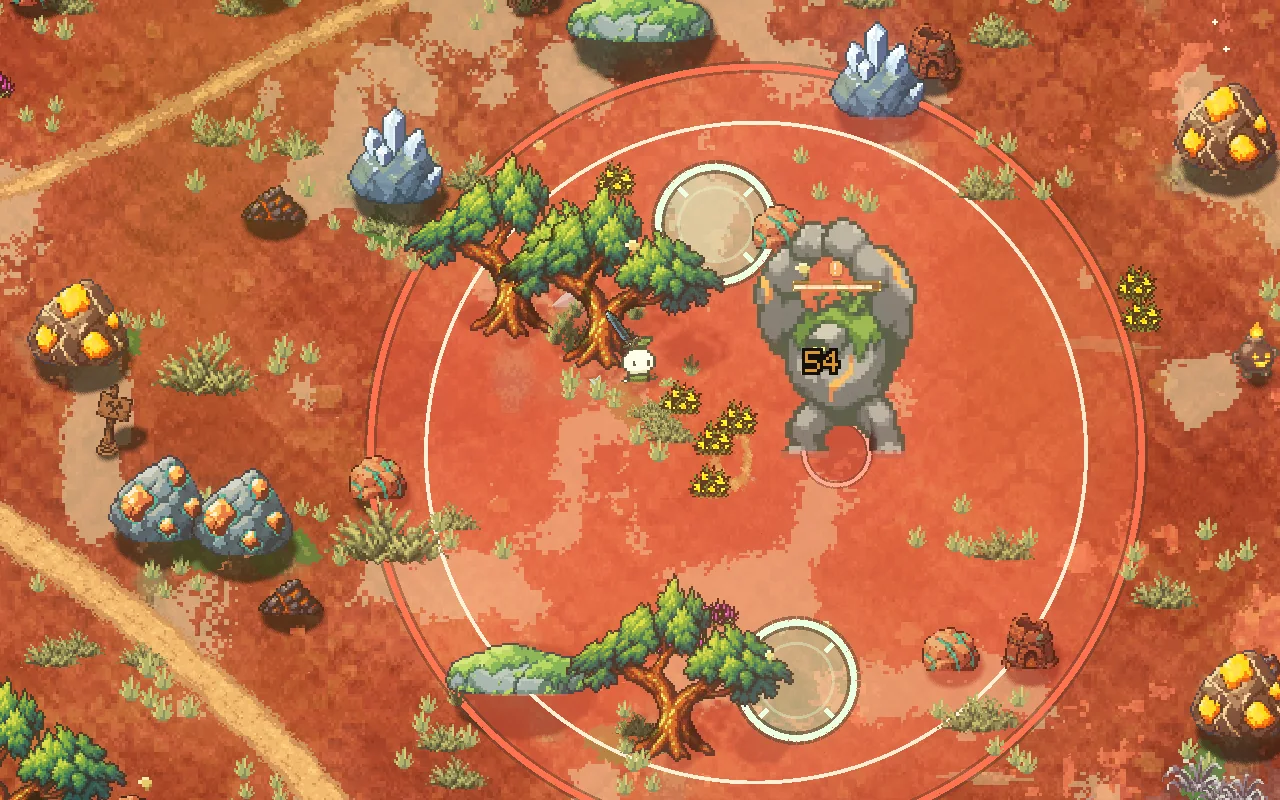
A warning that's easy to see on grass can vanish on red clay or snow. Every shape in Mytheria has a dark outline under it, which stays visible when the coloured fill blends into the ground. The fill itself is a thin wash, so you can still see the ground, the creature and anything else on the floor through it.
Warnings also draw on top of the night fog, so they stay visible at night. When most of the floor is dangerous, we mark the safe spots instead: during a boss's ground quake, the safe circles are cut out of the warning cleanly, with a bright rim around each one.
One colour language for every enemy
Every creature in Mytheria uses the same colours, so you only learn them once:
- Red means the attack will hurt, so dodge it.
- Blue means you can counter it by striking in the last 0.5 seconds before it lands.
- Gold marks an exposed weak point to hit now.
- Pale means the creature can't be hurt right now, so get away.
That's also why our own hit effects are magenta and violet, colours no warning uses.
Don't rely on colour alone
Some players can't tell red from blue easily. Mytheria has a Warning shapes option under Accessibility: red danger areas get diagonal hatching, blue counter areas get rings, and exposed weak points get a sparkle, so each warning can be read without its colour.
Drag the line to compare before and now
Give players a way out
A telegraph is only fair if the player can act on it. You can walk out of the shape, or dash: the dash makes you untouchable for 0.2 seconds from its start, so a well-timed dash through an attack works too.
The same rule holds for the strongest creatures in the world: even a giant in a danger zone rears up before its first blow, as monster camps and danger zones in an open world shows.
A checklist for telegraphing attacks
- Draw the exact area of the hit.
- Show the timing with a clock that fills.
- Give bigger hits more warning time.
- Keep warnings readable on every ground and at night, with a dark edge and a light fill.
- Use one colour language for every enemy, and add shapes for players who can't rely on colour.
- Always leave the player a way out.
Further reading
- How to make combat feel goodHow we made combat feel good in our indie game Mytheria: hitstop, hit flash, knockback and screen shake, with real frame data you can try yourself.
- Every enemy attack should warn you firstOur Short on how Mytheria's enemies tell you they're about to attack.
- MytheriaThe game these creatures live in: a pixel-art co-op adventure for one to four players.
Wishlist Mytheria
Mytheria is a pixel-art co-op adventure for one to four players, coming to Steam for Windows, macOS and Steam Deck. A wishlist is the best way to follow it and to help us.