Boss fight design: five bosses and what each one tests
How we design Mytheria's boss fights: a sealed door, an intro, three phases with a breather between, patterns that test something new and a real fall.
On this page
When a boss feels like another monster with more health, the player who walked a long way and prepared for it is let down. In Mytheria, our pixel-art co-op game, each of the five regions ends in a temple boss, and we design each one as an event with its own opening and ending.
Every clip below is from the game, filmed for this post.
What makes a good boss fight?
A good boss fight tests the skills the area taught you in a way you haven't seen yet. It has a clear start, phases that change the fight as it goes, attacks you can read and learn, and a proper ending. The player should lose a few times, understand why, and come back better.
The short answer
How we design Mytheria's bosses:
- The fight starts with a sealed door, an intro and its own music.
- The arena is about twice the size of a normal temple room, so there's room to move around the patterns.
- The boss has three phases, changing at 70 % and 40 % of its health, with a short breather between them.
- Each phase opens with its signature attack, so you see what changed straight away.
- The patterns are built from a few pieces, such as rings with gaps and bullets that bend.
- Every attack uses the same warning colours as everywhere else in the game.
- When the boss falls, the game slows down, the camera pushes in, and the region is freed.
Five bosses, five tests
Pick a boss. Each clip shows the fight crossing into its second phase:
Choose a boss to see its fight
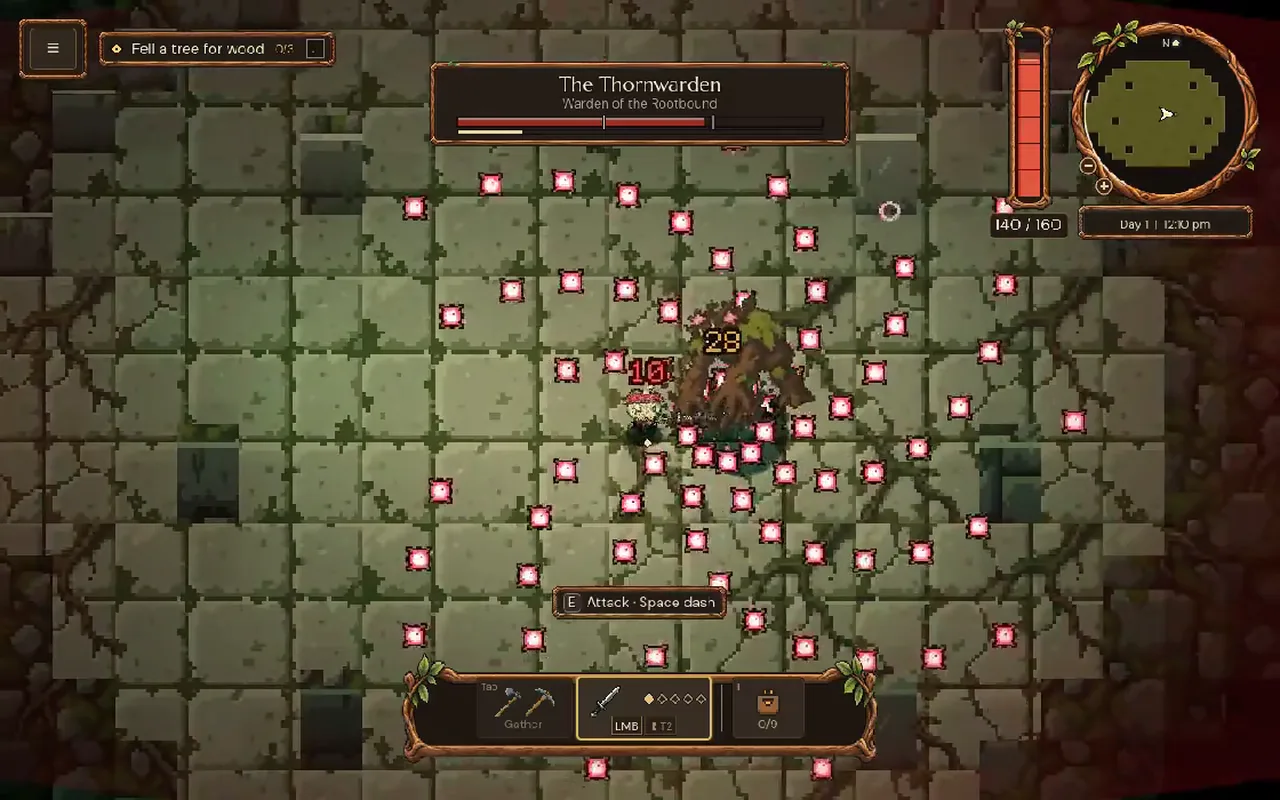
The Thornwarden, keeper of the Woodland: root lunges in red lanes, snares, thorn walls with gaps, and a crush you can counter. Its second phase, "The brambles wake", adds a ten-arm pinwheel of bullets. It tests reading lanes and finding the gap.
Make the boss an event
The fight starts before the first hit. A boss floor has its own music, rising from a drone and a heartbeat as you approach. (How the rest of the game's music works is in game music that leaves room for silence.) The arena is behind a great door with a glowing seal, and you break the seal by hand. The camera then pushes in on the boss under letterbox bars while its title appears. During this intro, 3.2 seconds the first time and 1.4 on a retry, the boss can't hurt you or be hurt, so the moment is never cut short by a stray hit.
Give the fight room
Bullet patterns need space to dodge through. Our boss arenas are 30 by 18 tiles, with 220 to 239 tiles you can walk on, about twice the floor of an ordinary temple room and about one screen wide, so you can see a whole pattern at once and learn it. The nine floors above each arena are covered in dungeon design.
Use phases to change the fight
Each boss has three phases, starting below 70 % and 40 % of its health. When the boss crosses one of those lines, it finishes what it's doing, then stops for 2.4 seconds: it can't be hurt, its bullets vanish, a card names the new phase, and the music can change. The pause gives the player a breath and makes it clear that the fight just changed.
Each new phase then opens with its signature attack first, so the player meets what's new immediately instead of wondering why the fight feels different.
Build patterns from a few blocks
Every boss pattern is built from the same handful of pieces. A ring of bullets can leave lanes open to slip through, and turning each volley the other way makes two spirals cross into a lattice. Bullets can bend as they fly, forming galaxy shapes. On the ground there are lanes and spokes, and quakes that hit everywhere except a few safe circles.
Combined in different ways, those few pieces give five bosses that feel completely different, built on one system. A volley holds at most 24 bullets, so the patterns stay readable.
Keep every attack readable
A boss can be hard and still fair. Every boss attack uses the warning language the rest of the game uses: red areas will hurt, blue ones can be countered, gold marks a moment to deal damage. We explain that system in telegraphing attacks. Bosses are also heavy: hitting one bounces you back and barely moves it, which we cover in big enemies that feel heavy.
Measure the difficulty
Boss strength is measured, not guessed. Each boss is fought in its own arena, and how long the fight takes and how much it hurts set the boss's health and damage in a data file, on top of the region's own difficulty. In co-op, a boss gets stronger for each extra player, fixed at the moment it wakes, so the fight stays a fight with friends.
Give it a real ending
When the boss falls, the ending gets the same care as the start. A warm flash and a short slow motion follow (the slow motion only when you're playing alone, so nobody else's game slows down), then a final shot pushes in on where it fell and a relic rises in its place. A card then says the region is freed, so the player knows they've beaten the whole region and not only one monster. Each keeper also leaves one line about who it used to be, part of a story told without cutscenes.
A checklist for boss fight design
- Build up to the fight with a door, music and an intro.
- Give the arena room for the patterns.
- Change the fight with phases, and give a breather between them.
- Open each phase with its signature attack.
- Build patterns from a few blocks you can combine.
- Keep attacks readable with one warning language.
- Measure difficulty, and scale it for co-op.
- Make the ending as big as the start.
Further reading
- Telegraphing attacks: how to warn players before a hitA telegraphed attack warns you where and when it will land. How Mytheria telegraphs every attack: a shape on the ground, a clock, more time for big hits.
- How to make big enemies feel heavy in combatHow Mytheria makes big enemies feel heavy: mass from size, blows that bounce you back, no flinching, and a stagger you earn. Try the weight split yourself.
- MytheriaFace these five yourself: a pixel-art co-op adventure for one to four players.
Wishlist Mytheria
Mytheria is a pixel-art co-op adventure for one to four players, coming to Steam for Windows, macOS and Steam Deck. A wishlist is the best way to follow it and to help us.