Dungeon design: ten floors, small puzzles and a boss at the bottom
How we design Mytheria's temple dungeons: ten hand-made floors, three tiny puzzle rules, a rest stop halfway, rising danger and a boss at the bottom.
On this page
A dungeon needs more than monsters: it needs a layout the player can learn, a rest partway through, and a reason to keep going down. In Mytheria, our pixel-art co-op game, every region has a temple: ten floors climbed down by stairs, a small puzzle on most of them, and a boss at the bottom.
The clips and stills below were filmed in the game for this post, and the map further down is drawn from the game's own floor data.
What makes good dungeon design?
A good dungeon has a clear goal, the way down, and a few simple rules the player learns early and then meets in new arrangements. Its difficulty builds steadily, it gives you a safe place to rest halfway, and it saves the boss for the end. Hand-made layouts help, because every room can be shaped to teach or test one thing.
The short answer
How we design Mytheria's temples:
- Each temple has ten hand-made floors, the same every time you visit.
- Every floor follows one of three rules: an open stair, a door that counts its guardians, or a door that waits for lanterns.
- The door shows the rule, with one socket for each guardian or lantern.
- Floor 5 has a waystone that heals you and lets you start there next time.
- Danger rises a few percent with each floor.
- A cleared floor stays cleared.
- The boss waits at the bottom, behind a great door you open yourself.
- A tool checks every map, so the way down can't be reached around a locked door.
Keep the puzzles small
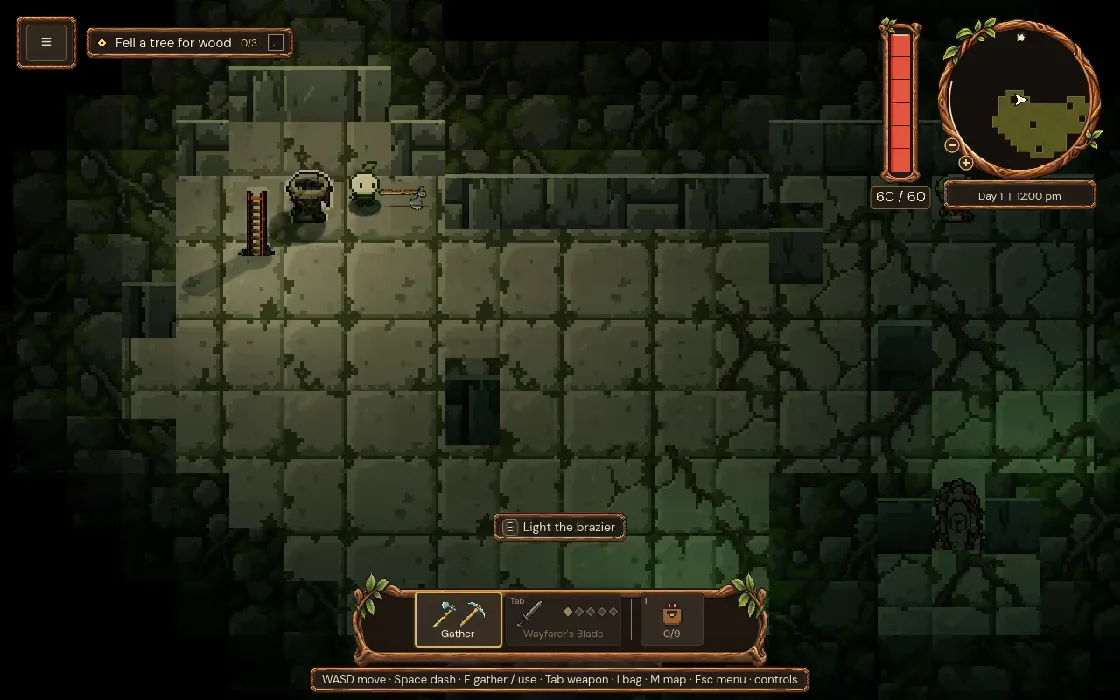
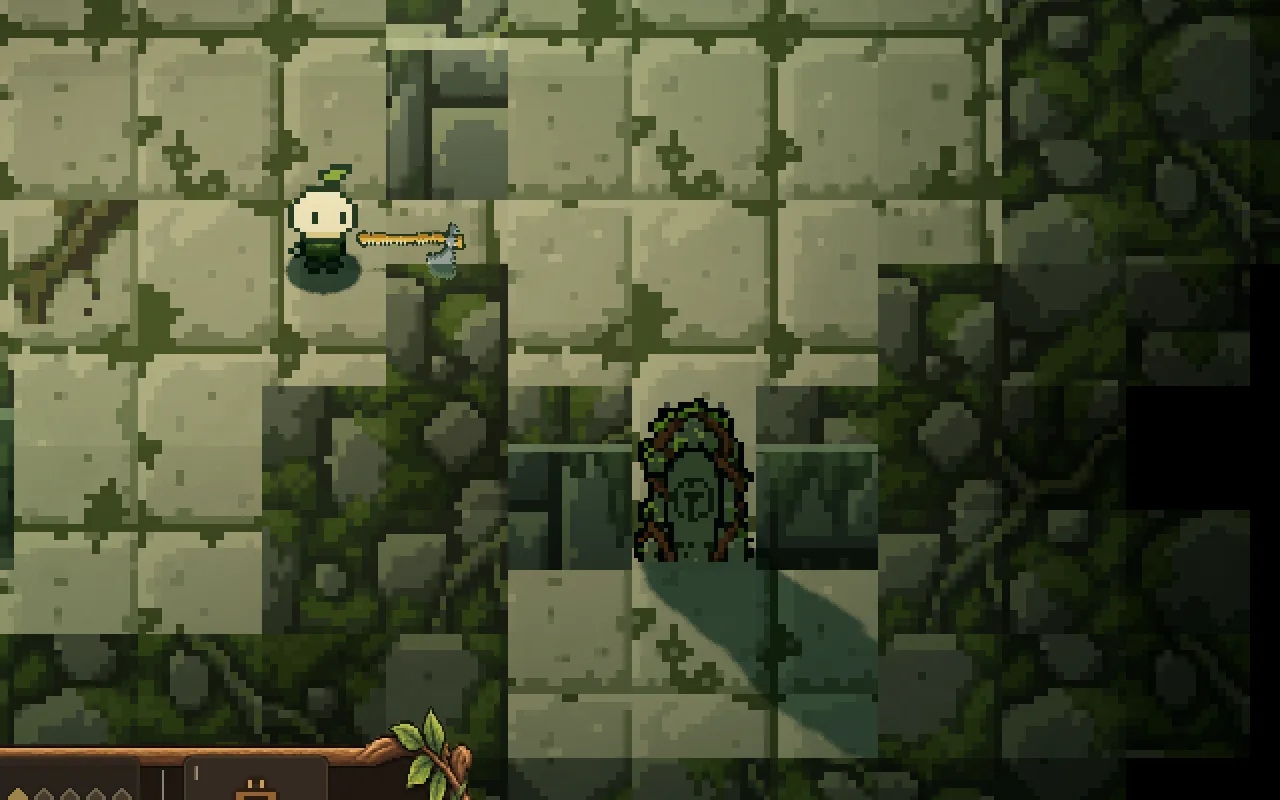
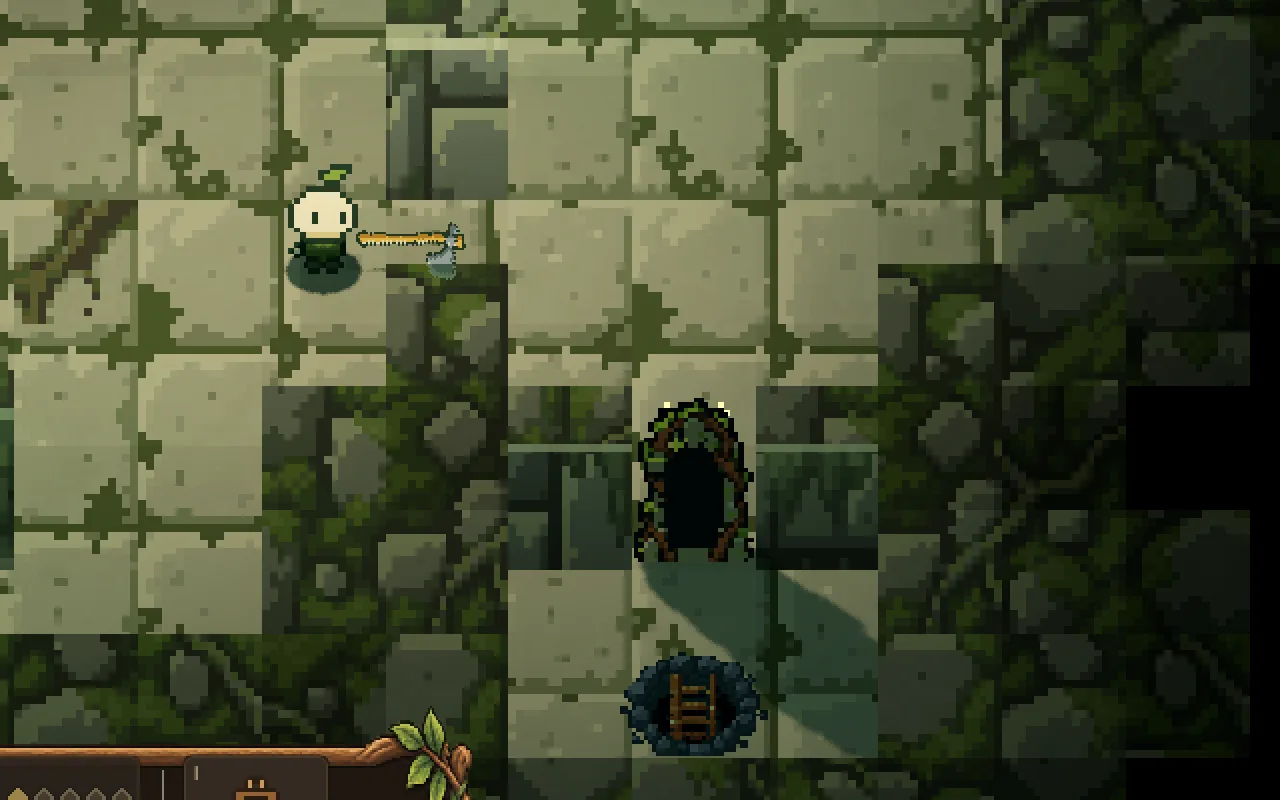
Each floor follows one of three rules, and the rules never change. On an open floor, the stair down is free to take. On a seal floor, a rune door blocks the stair; it has one socket for each guardian on the floor, each guardian you defeat fills a socket, and when they're all filled the door opens. On a lantern floor, the door has one socket for each brazier, and lighting a brazier fills a socket and lights up a part of the floor.
Those three rules are the whole puzzle system, and we keep it small on purpose: in a game about fighting and exploring, a puzzle should be something you understand at a glance and solve by playing. The clip at the top is a lantern floor with three braziers and three sockets, where the room gets brighter with each one until the door opens. This is a seal floor's door before and after its guardians fall:
Compare the door, or use the arrow keys
The rune door shuts off the stair. Its sockets count the floor's three guardians.
Mix three rules into ten floors
With only three rules, the variety comes from the rooms. These are all ten floors of the Rootbound Temple, the first temple in the game, drawn from the game's data. Pick a floor, then open or shut its door. The highlighted tiles are everything you can reach from where you arrive:
Pick a floor, then open or shut its door
- Arrival
- Stairs
- Door
- Pillar
- Brazier
- Guardian
- Reachable
Loading the floors…
Floor 1 is an open hall that only teaches you that floors go down by stairs. Floors 2 to 4 introduce the rules one at a time: a seal door, then lanterns, then a seal door again in a room with a wall to fight around. Floor 5 is the rest stop, with one guardian and a waystone in the middle of the room.
Floors 6 to 9 combine the rules with bigger groups, split halls and pillars to use as cover. Floor 8 rehearses the boss: the Rootbound Temple puts an antlered duelist there, which uses the same kind of counter window as the boss on floor 10.
Raise the danger slowly
Guardians get a little tougher on every floor down: 7 % more health and 4 % more damage per floor. By floor 9, they have 1.56 times their normal health and hit 1.32 times as hard. Small steps like these add up without any single floor feeling much harder than the one before. The number of guardians grows too, from three on the first floor to five on floors 7 and 9.
Give the player a place to breathe
Floor 5 holds a waystone, like the ones that link the island's surface (see fast travel design). Touch it once and it remembers you: from then on, the temple entrance can take you straight to floor 5. Stand near it unhurt for three seconds and you heal, 5 health every second. A rest stop halfway splits a long climb into two shorter ones, so losing on floor 8 costs much less. Healing is scarce everywhere else in the game, which is what makes a rest stop worth reaching; why is in health regeneration vs health pickups.
Let progress stick
Once a floor's guardians fall or its braziers are lit, the door stays open for good and no new guardians are posted there. Only the boss comes back, at dawn, so you can fight it again for its loot. Climbing back down after a defeat costs a walk, and you never solve the same puzzle twice.
End with the boss
Floor 10 is bigger than the others: 30 by 18 tiles instead of 20 by 14. You arrive in an antechamber, and a great door with a glowing seal stands between you and the arena. You break the seal by hand, so the fight starts when you're ready. How the fights themselves are designed is in boss fight design, and why the temples matter to the bigger day-and-night loop is in game loop design.
Check every map with a tool
A locked door only works if there's no way around it. Every temple map is checked automatically with a flood fill: start at the arrival, walk to every tile you can reach without passing a locked door, and make sure the stair down isn't one of them. Then open the door and make sure it is. The same check runs on the boss floor's great door, and the map above shows the same flood fill when you open and shut a door.
A checklist for dungeon design
- Pick a clear goal for each floor: the way down.
- Use a few small rules, and show each rule in the world.
- Teach one rule at a time before combining them.
- Raise difficulty in small steps.
- Put a rest stop and a shortcut halfway.
- Let solved floors stay solved.
- Rehearse the boss's mechanic a floor or two above it.
- Check every map automatically, so no lock can be walked around.
Further reading
- Boss fight design: five bosses and what each one testsHow we design Mytheria's boss fights: a sealed door, an intro, three phases with a breather between, patterns that test something new and a real fall.
- Game loop design: gather by day, survive the nightMytheria's core gameplay loop as a real example: a daily loop of gathering and night danger inside a region loop of settlements, upgrades and bosses.
- MytheriaClimb down the temples yourself: a pixel-art co-op adventure for one to four players.
Wishlist Mytheria
Mytheria is a pixel-art co-op adventure for one to four players, coming to Steam for Windows, macOS and Steam Deck. A wishlist is the best way to follow it and to help us.