Fast travel design: waystones that respect the map
How Mytheria's fast travel works: 17 waystones where you'd go anyway, unlocked by visiting, priced by distance, and a channel that a single hit breaks.
On this page
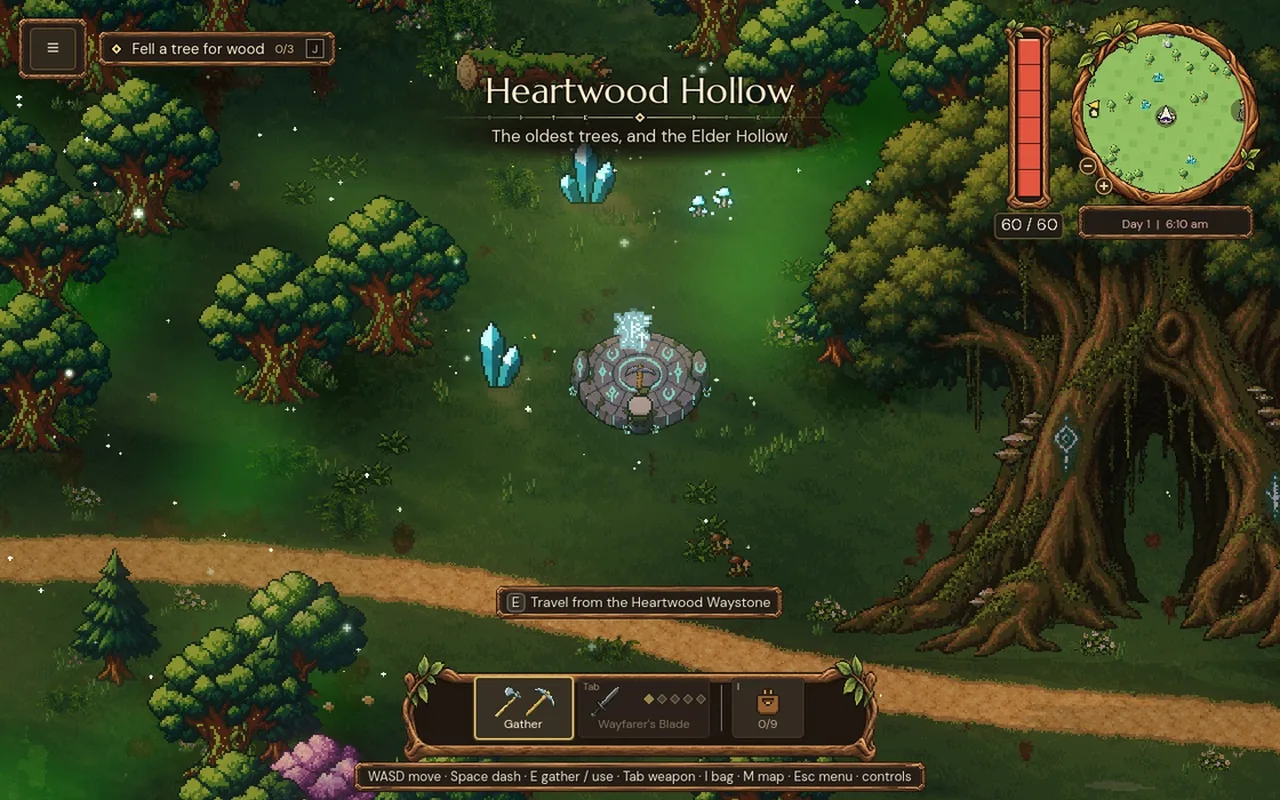
Fast travel needs a balance. Without it, crossing a big map for the tenth time is a chore, and with too much of it, the map turns into a menu and the journey stops mattering. In Mytheria, our pixel-art co-op game, fast travel runs through waystones: old portal circles you have to find and walk onto before you can travel to them, placed at the spots you'd be heading to anyway.
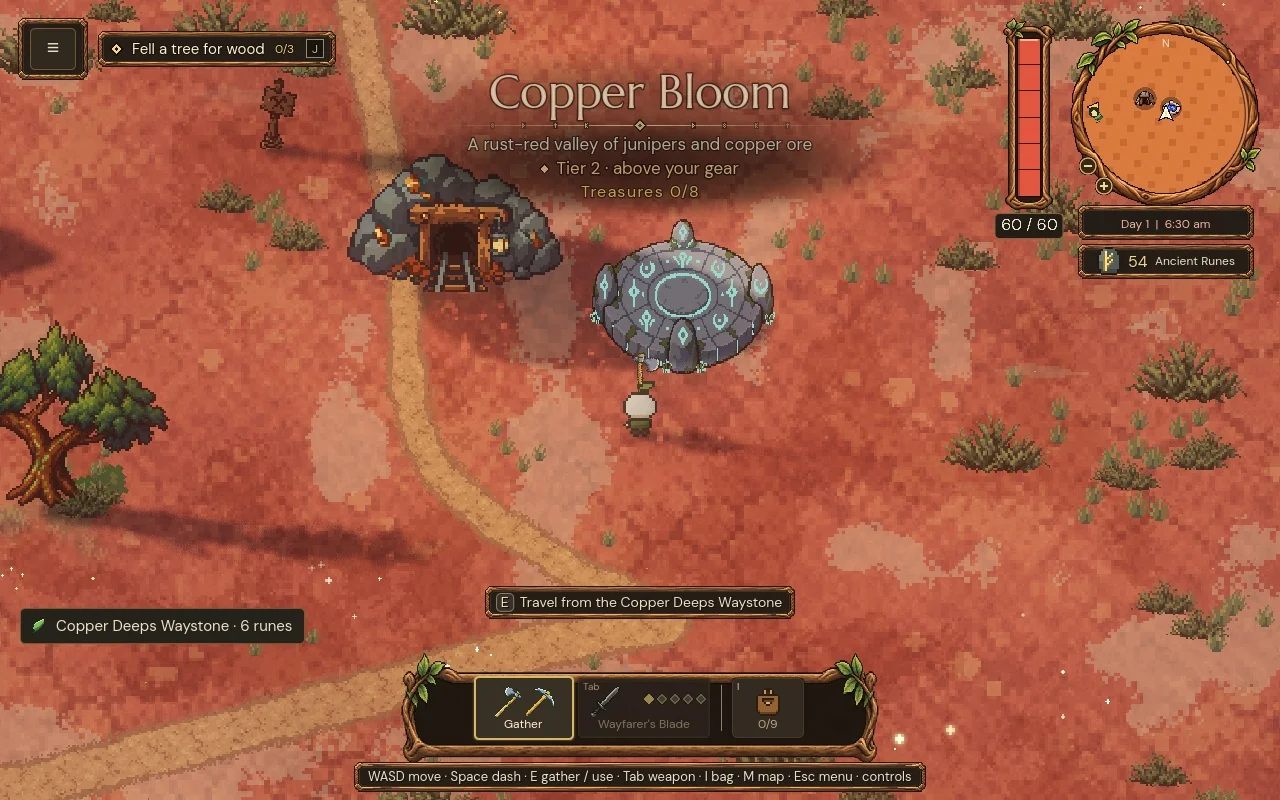
The clip at the top was filmed for this post, in one take with real input: walking onto a waystone, opening the travel map and arriving in the next region.
How should fast travel work in a game?
Good fast travel removes repeated walks and leaves exploring alone. Players unlock destinations by reaching them on foot first, so the first trip is always a journey. Destinations sit where players need to return, such as towns and dungeon entrances. A small cost or a short wait makes each trip a decision, and it shouldn't work as an escape from a fight.
The short answer
How Mytheria's waystones work:
- There are 17 waystones, at settlements, mine and temple entrances and long crossings, plus the Rune Circle at home.
- Walk onto one once and it's unlocked for everyone in the world.
- A trip can only start at a waystone or at home.
- The price depends on distance: one rune per 1,000 units, at least 2, and half price going home.
- Travelling takes 3.75 seconds of standing still, and a hit, a fall or a step breaks it.
- In co-op you can travel straight to your partner's side, even underground.
- Rules keep every stone beside a road, clear of camps and danger, and free of plants.
Put stones where players already go
Fewer stones make each one matter: 42 was far too many in a playtest (see what one co-op playtest changed), and every one of today's 17 marks a place the player has a reason to come back to. Each region's settlement has its portal, every mine and temple has a circle by its entrance, and four hubs fill the long empty stretches between them. The hub at Heartwood, for example, stands at a crossroads in the eastern Woodland that otherwise sat in a gap of about 26 seconds of road in each direction. The same kind of gap measure, for everything on the map, is in how to make a game world bigger without making it empty.
Try it on the real layout. Click a stone to start from, then one to travel to. Then hide the hubs and watch the longest stretch of road with no stone near it grow:
Click a stone to start from, then one to travel to
- Hub
- Mine or temple
- Settlement portal
- Rune Circle (home)
Loading the island…
Unlock by visiting
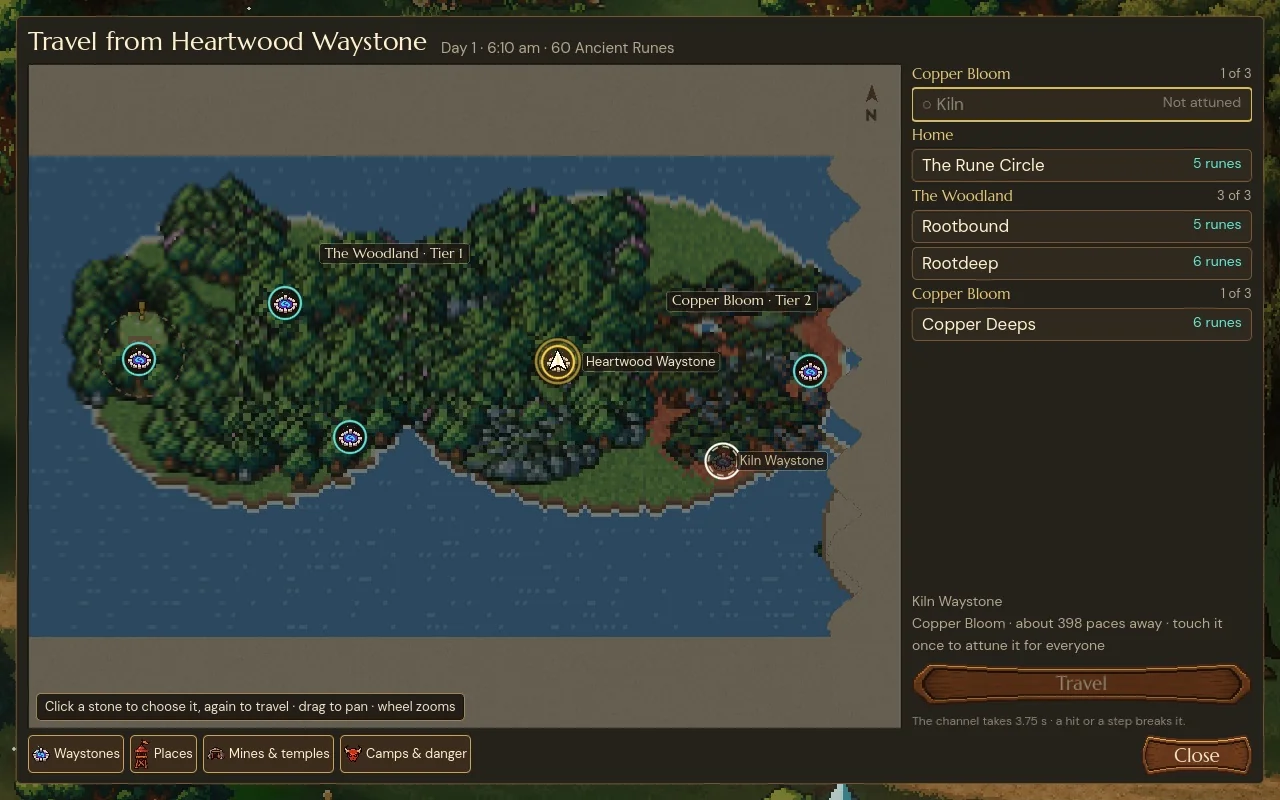
A waystone starts dormant, its runes faint. Walk onto it once and it wakes for the whole world: everyone playing in that world can travel there from then on. The player who found it gets the moment, a title card and a short camera move; everyone else gets a notice saying who woke which stone. As a result, every destination on the travel map is somewhere a player has actually been. Stones you've seen but not touched appear greyed, with a note to touch them first.
Make it cost something, a little
A trip costs runes, the game's shared currency, by distance: one rune for every 1,000 units, at least 2. Going home costs half. In the clip, Heartwood to Copper Deeps is about 5,200 units and costs 6 runes. The price is low on purpose: high enough that you'd walk a short hop rather than pay for it, and low enough that you never walk across a region to save runes. Where runes come from is in game economy design.
Don't let it be an escape
Travel takes 3.75 seconds of channelling at the stone, and it breaks if you're hit, fall, or step more than a few units away, so you can't fast travel out of a fight that's going badly. You also have to be standing at a waystone or at the Rune Circle at home to start a trip.
Bring friends together
In co-op, the travel map has one more destination: your partner. Choose them and you land right beside them, wherever they're standing, even on a mine or temple floor. If they're in a boss fight, you arrive at the arena's door. The price is worked out by distance to where they are, or to the entrance of the mine or temple they're in.
Place them by rules, and check the rules
Each waystone is a flat portal circle on the ground that you walk onto, and it doesn't block movement. For it to read clearly, its ground has to stay clear, so its placement follows rules that an automatic check enforces on every build. A stone sits on dry land beside a road, at least 150 units from every monster camp and danger zone, so you never land in a fight. Grass, ferns and trees keep off every circle, and the world has between 15 and 20 stones, with at least two hubs.
The same circle icon marks every waystone on the minimap, the full map and the travel map, so it reads as one thing everywhere. How those maps are designed is in minimap design.
A checklist for fast travel design
- Unlock destinations by visiting them on foot.
- Put them where players already return: towns, entrances, crossroads.
- Fill the longest empty stretches with a few extra stops.
- Start trips only from travel points.
- Charge a little, by distance.
- Let a hit cancel the trip, so it's never an escape.
- In co-op, let players travel to each other.
- Check placement rules automatically.
Further reading
- Minimap design: show only what helps the playerHow we designed Mytheria's minimap: a calm round window, icons that keep their size, arrows on the rim, and six zoom steps. Real footage from the game.
- Game economy design: setting prices with a curveHow we balance Mytheria's game economy: target curves for enemies and income, a model that sets every price, and play tests that check the model.
- MytheriaWake the waystones yourself: a pixel-art co-op adventure for one to four players.
Wishlist Mytheria
Mytheria is a pixel-art co-op adventure for one to four players, coming to Steam for Windows, macOS and Steam Deck. A wishlist is the best way to follow it and to help us.