What one co-op playtest changed in our game
One two-player playtest of Mytheria, the notes it produced, how we sorted them, and the changes they led to, from loot pickup to the world map.
On this page
Testing a co-op game alone misses many of its problems. A rejoin that loses your bag, or a dawn that arrives on one screen before the other, only shows up with two people on two computers. One long two-player session of Mytheria, our pixel-art co-op game, produced about fifty notes. This is how we sorted them and what they changed.
How do you run a useful co-op playtest?
Play the real build on separate computers, the way players will, for long enough to reach the second and third day. Write every note down the moment it happens, in plain words, without deciding anything. Afterwards, split the notes into bugs to fix and decisions to make, sort the bugs by how badly they break play, and fix each one with a check that fails on the old version.
The short answer
What we do with a playtest:
- Write each note down as it happens, exactly as it felt, typos and all.
- During the session, play and take notes without fixing anything.
- Split bugs from decisions: a lost bag is a bug, and "make it grindier" is a decision.
- Fix what breaks play first, then balance, then the map, then polish.
- Treat the numbers in the notes as guesses to try in play.
- Give every fix a check that fails on the old code.
- Replay the whole session on every new build, so the same bugs can't come back.
Write it all down, and decide later
During the session the only job is to play and write. A note like "the new day doesn't show up for everyone at the same time" is worth more than a fix made on the spot, because the fix can wait, while the exact feeling is hard to recall later. The notes stay word for word in their own file; the discussion goes in a separate one.
Split bugs from decisions
About half the notes were plain bugs, like a guest losing their items on rejoining or a weapon not firing in the home meadow. The other half were wishes and questions, like harder bosses or a grindier pace. Bugs go straight on the fix list, while decisions get written up as clear questions with a recommendation, and nothing that depends on them starts until they're answered.
Sort by what breaks play first
These are twelve of the notes and what each one became. Read them in the order they were written, then sort them into the order we worked through them:
Sort the notes, then open one to see what changed
-
Before: A broken tree or rock left its shadow behind.
Now: The shadow leaves with it.
-
Before: Partners were hard to find.
Now: Partners show on every map in their own colour, with an arrow at the edge when they are out of view.
-
Before: Each screen reached the dawn on its own.
Now: The world sleeps together: every screen goes dark at 06:00 and wakes to the same morning.
-
Before: The map could only zoom.
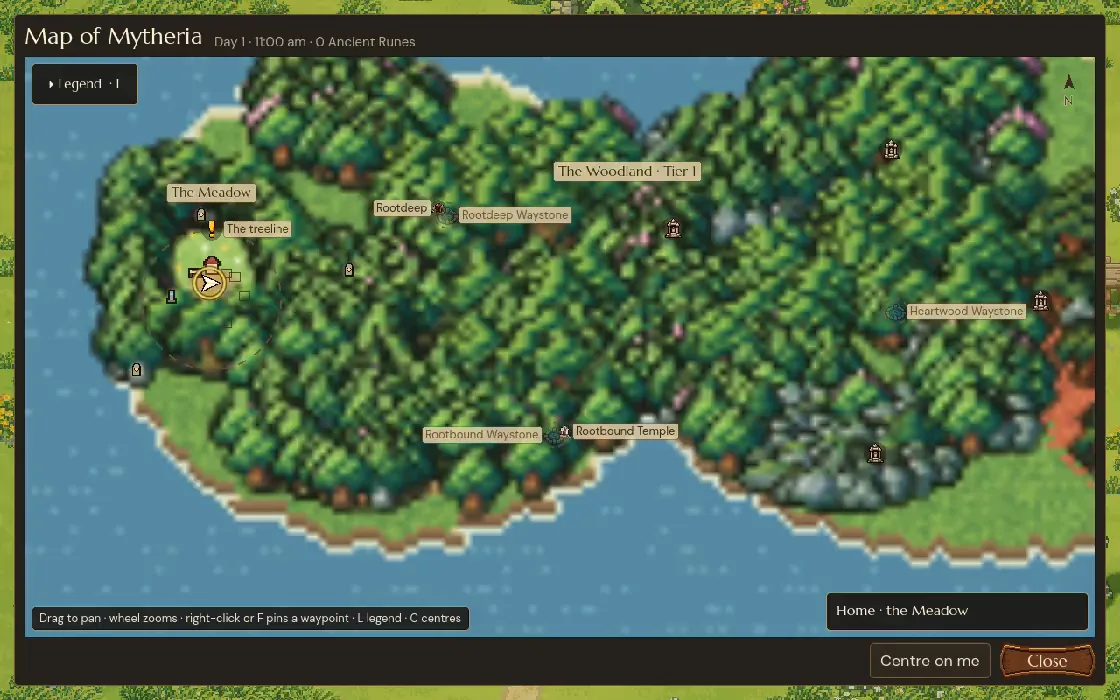
Now: Drag to pan, the wheel zooms at the pointer, and a right-click or F pins a waypoint every player sees.
-
Before: 0.6 seconds before a drop could be collected.
Now: 0.1 seconds.
-
Before: It didn't take you all the way to them.
Now: You land where your partner is when the channel ends, even underground.
-
Before: 42 Waystones and a 2.5 second channel.
Now: 17 Waystones plus the Rune Circle, at settlements, entrances and long gaps, with a 3.75 second channel.
-
Before: A returning player started from scratch.
Now: Characters belong to the world: save, quit, restart and rejoin keeps the same character, items, gear and Waystones.
-
Before: A dash only moved you.
Now: A dash makes you untouchable for 0.2 seconds, and recharges a little slower: 0.76 seconds instead of 0.65.
-
Before: 3 to 5 logs a tree.
Now: 1 log, with a 50 % chance of a second.
-
Before: A sealed region was found from about 1,300 to 1,900 units away.
Now: You find it within 300 units of its edge.
-
Before: The bag was big from the first minute.
Now: It starts with 9 slots, and the Deep Pockets upgrade adds a row to everyone's bag, up to three times.
The order matters because the notes depend on each other: nobody can judge the balance if a rejoin wipes their bag, or judge a map they can't drag. So the work went from what breaks play to progression and balance, then the maps, then bosses and danger zones, and finally world polish.
Treat numbers as guesses
The notes come with numbers: "half a second", "like five logs", "maybe 50 % longer". We wrote proposals next to them, a pickup delay of 0.1 seconds, a channel of 3.75 seconds, a quarter second of dash protection, and then tried each in play. Some stayed as proposed and others changed: the dash protection ended at 0.2 seconds, and the recharge at 0.76 instead of 0.9. A note tells you where the problem is, and play tells you what the number should be. Loot pickup itself is in loot drops that feel good to pick up, and the Waystones in fast travel design.
Prove every fix
Each bug got a check that fails on the old code and passes on the new: the game file set back to the old version for one run proves the check would have caught it. Then the whole session became a repeatable run on two real builds of the game, doing what the playtest did: building, travelling, mining, quitting mid-night and rejoining. Its final run passed all 50 of its checks. The same list-and-rank habit runs our visual polish too: see how we decide what to polish first.
Make the map a tool
The note that changed the most visible part of the game was about the map. A map you can only zoom is little more than a picture, while a map you can drag, read and mark is something you plan with. Now you drag it, zoom where you point, and pin waypoints that your partner sees too. The clip at the top of this post is that map in use.
A checklist for a co-op playtest
- Play the real build on separate computers.
- Play long enough to reach the second and third day.
- Write every note as it happens, and decide later.
- Split bugs from decisions.
- Fix what breaks play first.
- Treat every number in the notes as a guess to test.
- Give every fix a check that fails on the old code.
- Make the session something you can run again on every build.
Further reading
- Loot drops that feel good to pick upHow Mytheria's loot drops work: a real arc and one bounce, a pale outline to stand out, a magnet that pulls them in, and text that adds up the haul.
- Fast travel design: waystones that respect the mapHow Mytheria's fast travel works: 17 waystones where you'd go anyway, unlocked by visiting, priced by distance, and a channel that a single hit breaks.
- MytheriaPlay it with a friend: a pixel-art co-op adventure for one to four players.
Wishlist Mytheria
Mytheria is a pixel-art co-op adventure for one to four players, coming to Steam for Windows, macOS and Steam Deck. A wishlist is the best way to follow it and to help us.