How we decide what to polish first
How we choose Mytheria's polish work: rank every gap by what a player notices at play size, write down what success looks like, compare matched frames.
On this page
A game always has more to polish than there's time for. Every frame has a slightly wrong colour or a slightly stiff animation somewhere, and you could spend a year on any of them, so the hard part is choosing. In Mytheria, our pixel-art co-op game, every polish pass starts the same way: look at the game the way a player sees it, list what's wrong, and fix the thing they'd notice most.
How do you decide what to polish in a game?
Look at the real game at normal play size, in a few representative scenes, and write down every visible problem with a short note on when it shows. Rank them by how much a player would notice, even if an easier fix or a detail you see up close is more tempting. Before fixing the top one, write down what success looks like and what would count as failure. Then compare matched before and after frames.
The short answer
How we choose and finish polish work:
- We look at the game at play size first, because zoomed-in art shows flaws a player never sees and hides the ones they do.
- Every problem goes on a list, with the moment it shows up.
- The list is ranked by what a player would notice, biggest first.
- Before the fix, we write what the player should notice, what they see now, and what would make the change a failure.
- We fix the smallest thing that closes the gap.
- Before and after frames match in view, time of day and settings.
- What already works is left alone, and what belongs to another part of the game is written down for later.
- After two failed tries, we try a different approach.
Look at play size first
Pixel art is made zoomed in, and it's tempting to judge it there, but the player sees the whole frame at its normal size, moving. A one-pixel flaw you can see at 800 % may be invisible in play, while a haze that covers a third of the screen only shows when you step back. So every review starts with full frames at the size the game is played, and only then zooms in on details.
Rank by what the player notices
A polish pass on Mytheria's first hour, the meadow and the Woodland, listed seven areas at different times of day, each with its largest visible gap and the condition under which it shows:
- In the Woodland at dawn, a glowing pale veil covered a third of the frame and washed out the path and trees.
- At golden hour, orange blotches bigger than a tree crown lay over the Woodland grass.
- In the meadow by day, five bleached relic stands were the brightest and least readable things in view.
- On the temple approach, more than half the frame was bare lawn.
- On the first forest road, tree crowns crowded wall to wall.
- The meadow at dusk and at night looked right and needed nothing.
- The mine entrance and a monster camp were already the Woodland's best frames.
The top three were fixed. The fourth and fifth were real problems, but they come from how the world is laid out rather than from its lighting, so they were written down for their own pass. The last two were left alone on purpose.
Write the test before the fix
Before changing anything, each item gets a sentence: in this scene, the player should notice ___; the current build shows ___; the change fails if ___. For the dawn veil: at 06:40, if any haze hides a path or a trunk, or glows brighter than the sunlit lawn, the fix has failed. Writing the test first keeps the fix honest, because after making a change it's easy to like the result and decide that was the goal all along.
Fix the smallest thing
The veil and the blotches came from the same place: the golden-hour look makes the light shafts 1.2 times stronger, and at dawn and dusk, in the Woodland's sunlit clearings, that piled up into a glow. The fix was data only: at dawn and dusk the light shafts and the thickness of the air are turned down, and the evening's glow is thinner. Noon wasn't touched, and a noon frame from before and after matched.
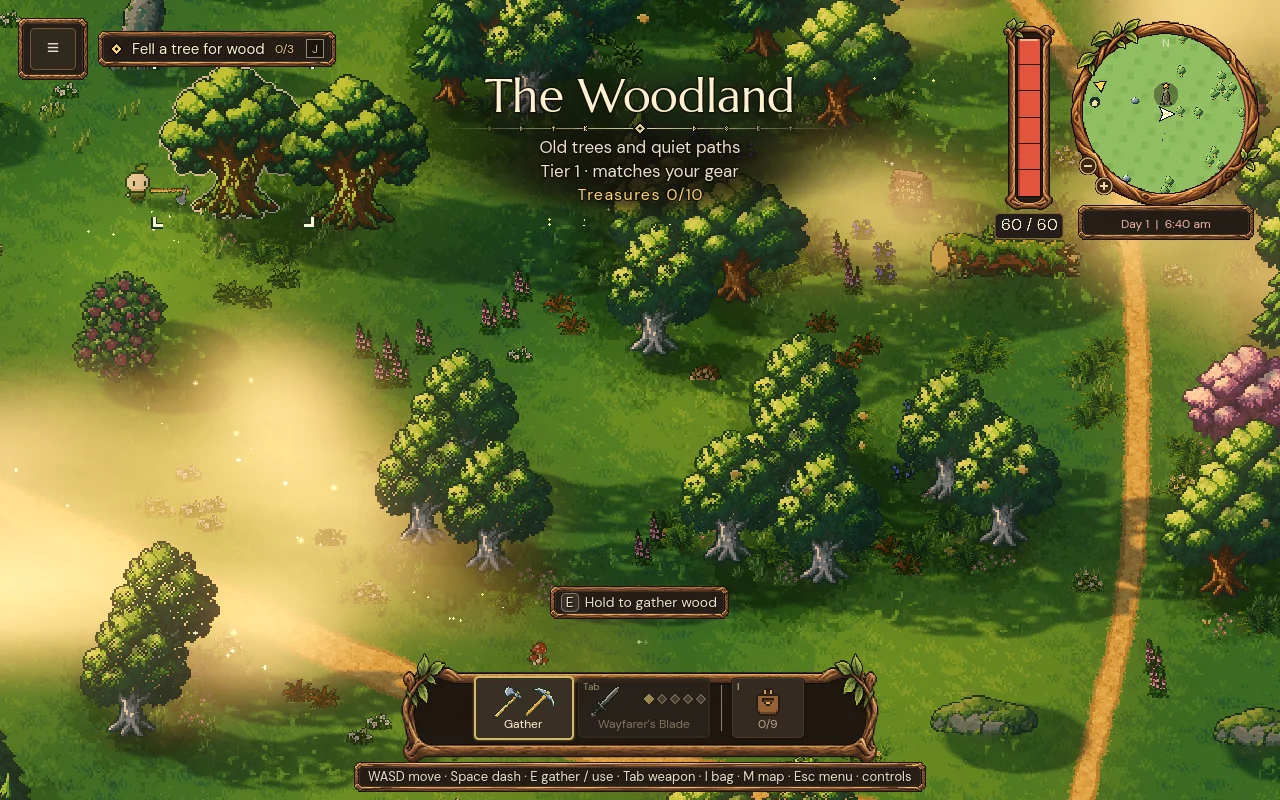
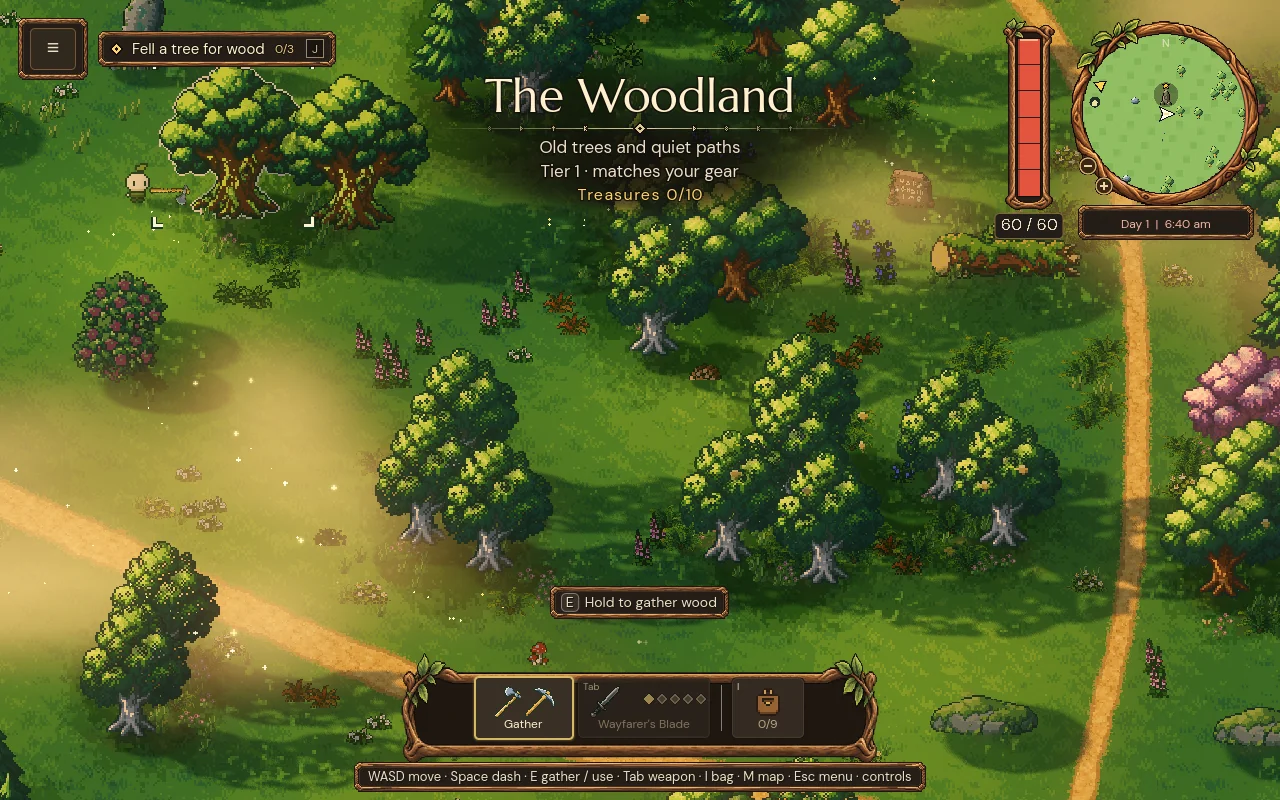
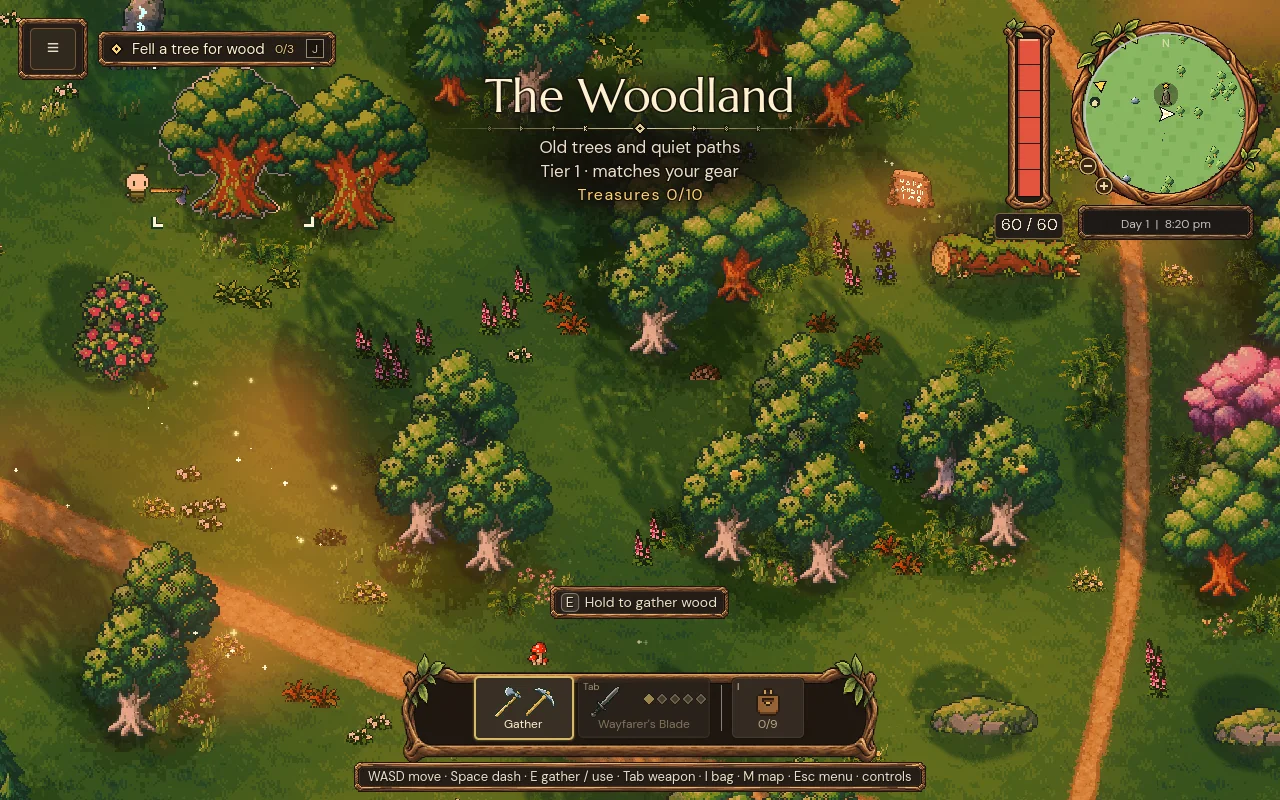
This is the same glade on today's game, rendered with the old values and with the new ones:
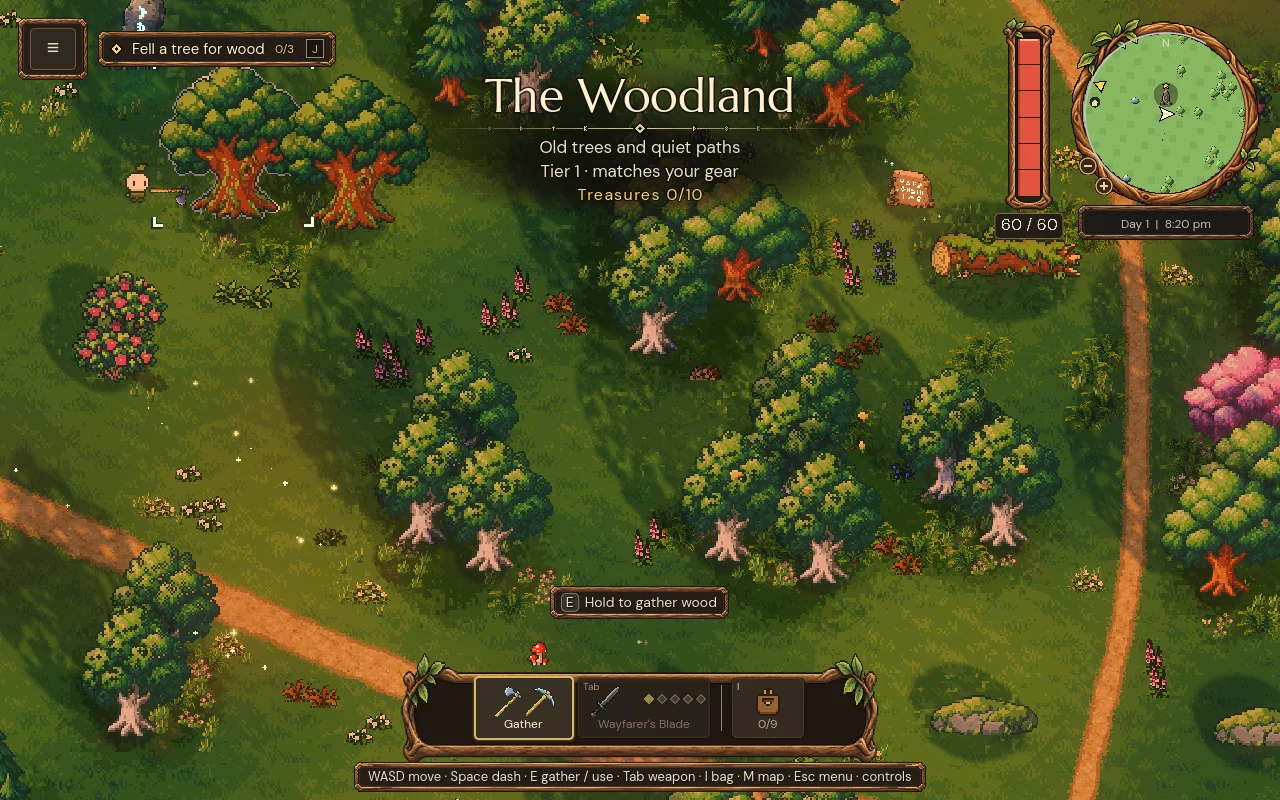
Step through the frames, or use the arrow keys
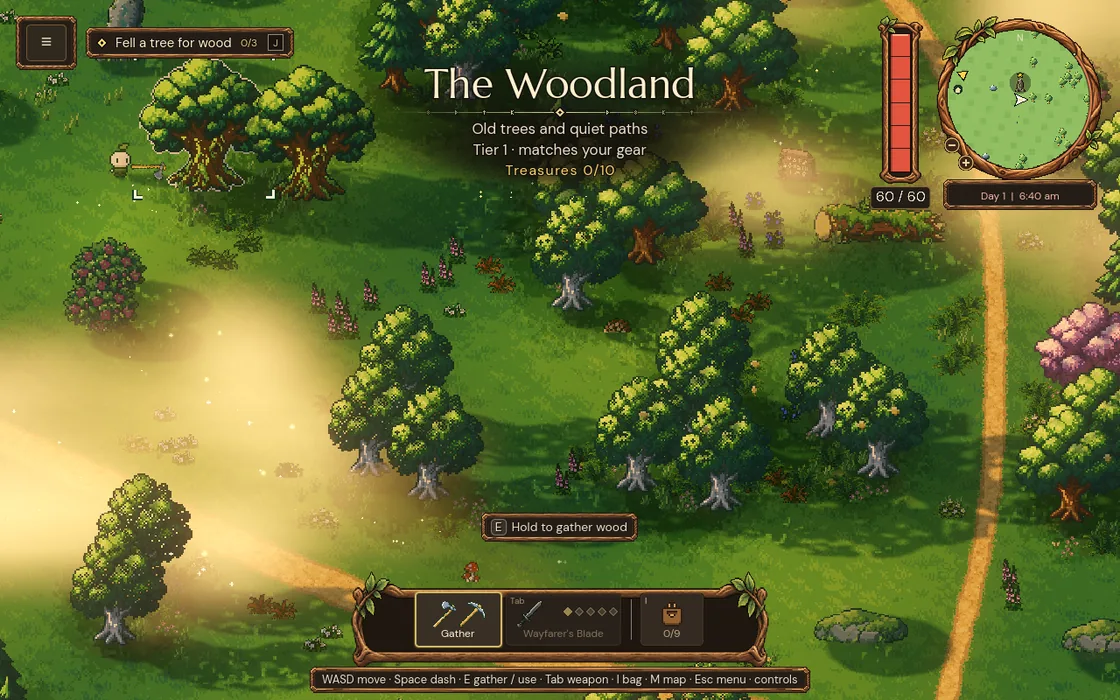
06:40 with the old values: a glowing veil over the left of the frame. The path and the trees under it wash out.
Measured on these frames, the left of the dawn image went from an average colour of 133, 136, 65 to 111, 120, 49, so the veil is gone and the scene keeps its warmth. How the lighting works in general is in pixel art lighting.
Compare matched frames
A before and after only proves something if the change is the only difference, so the scene, camera, time of day, settings and size must all match. We keep the scenes as small replay files, so the exact frame can be rendered again on any later version. That's how the frames above were made today: the old values swapped in for one render and put back.
Know when to stop
A polish item is done when the full frame at play size clearly shows the gap closed, nothing nearby got worse, and the test written before the fix passes. If two attempts in a row don't get there, the third attempt is a different approach, compared side by side with the first, and the test written at the start stays as it is. Playtests feed the same list; how we sort those notes is in what one co-op playtest changed in our game.
A checklist for choosing polish
- Review the real game at normal play size.
- List every visible gap with the moment it appears.
- Rank by what a player would notice.
- Write the success and failure test before fixing.
- Fix the smallest thing that closes the gap.
- Compare matched before and after frames.
- Check that nothing nearby got worse.
- Leave what works alone, and write down problems that belong to another part of the game.
- After two failed tries, change approach.
Further reading
- Pixel art lighting in Godot: real lights in the worldHow we light Mytheria's pixel art in Godot with real lights, local mist and time of day instead of screen filters. Drag the sun through a whole day.
- What one co-op playtest changed in our gameOne two-player playtest of Mytheria, the notes it produced, how we sorted them, and the changes they led to, from loot pickup to the world map.
- MytheriaSee the polish for yourself: a pixel-art co-op adventure for one to four players.
Wishlist Mytheria
Mytheria is a pixel-art co-op adventure for one to four players, coming to Steam for Windows, macOS and Steam Deck. A wishlist is the best way to follow it and to help us.