Game economy design: setting prices with a curve
How we balance Mytheria's game economy: target curves for enemies and income, a model that sets every price, and play tests that check the model.
On this page
A game with dozens of materials, weapons, armour, stations and upgrades has hundreds of prices. Set one by one, they drift until one region is a grind and the next is free, and nobody can say why. In Mytheria, our pixel-art co-op game, we decide first how the game should feel region by region, write that down as numbers, and let a model work out the prices that produce it.
The clips and stills below were filmed in the game for this post; the charts come from our balance model running on the game's data.
How do you balance a game economy?
Start from how the game should feel and work back to the prices. Decide how long each part of the game should take and how hard it should feel, as target ranges, and give every resource a value in one shared currency. Build a model of how fast a player earns, then derive the prices from the targets instead of typing them in. Finally, play the game and check that the model's predictions match what really happens.
The short answer
How we set Mytheria's prices:
- Every material has a value in runes, the game's currency.
- Target curves say how strong enemies get and how long each region should take.
- A model works out the income per day and what each region asks the player to buy.
- The prices are generated from rules like "a region's new weapon and tools cost about a day of its income".
- Every target in every region gets a pass or fail check.
- We play the game to check the model.
Give everything one value
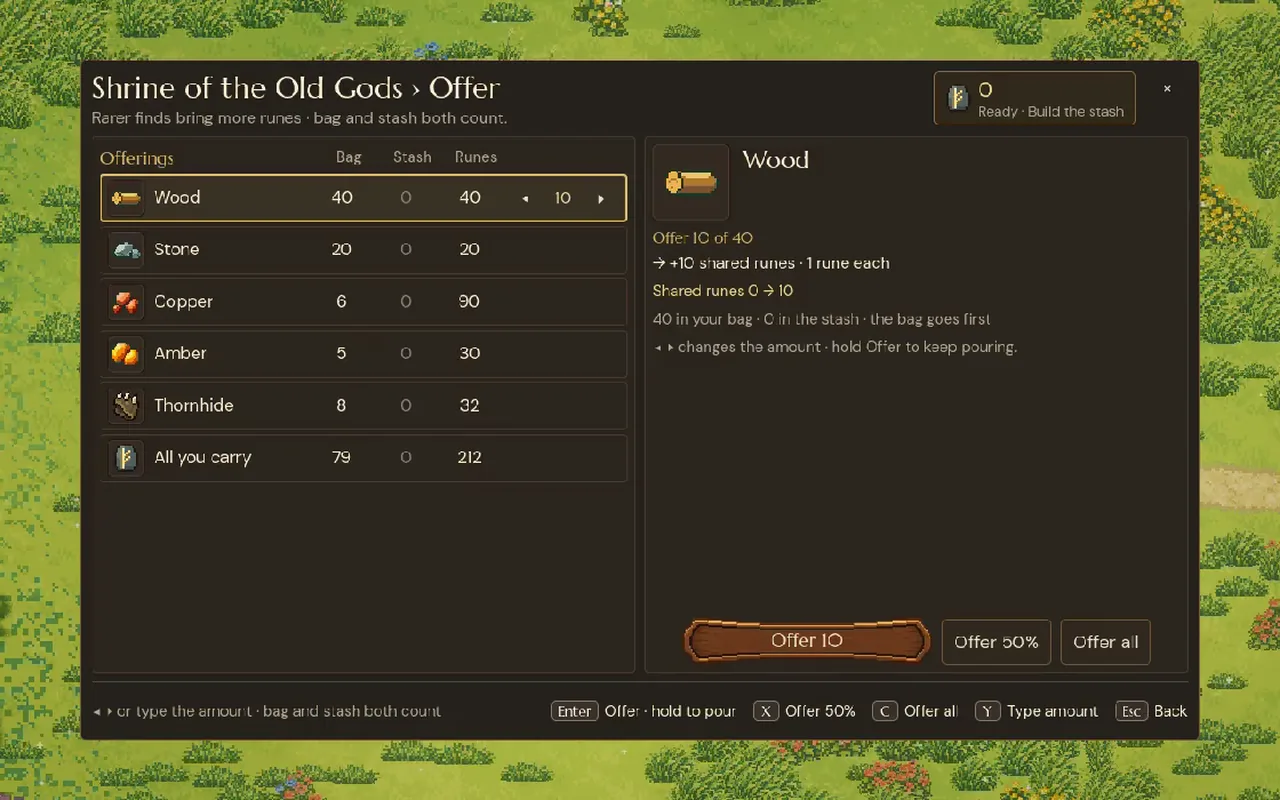
Wood, copper, monster hides and rare gems all need to be compared, so every material has a value in runes, the game's currency. A log is worth 1, copper 15, amber 6, a thornhide 4; the rarest finds near the end, heartstone and blight essence, are worth 234 and 230. You can see it in the game: the shrine turns anything you carry into runes at these values, and a little more once it's upgraded.
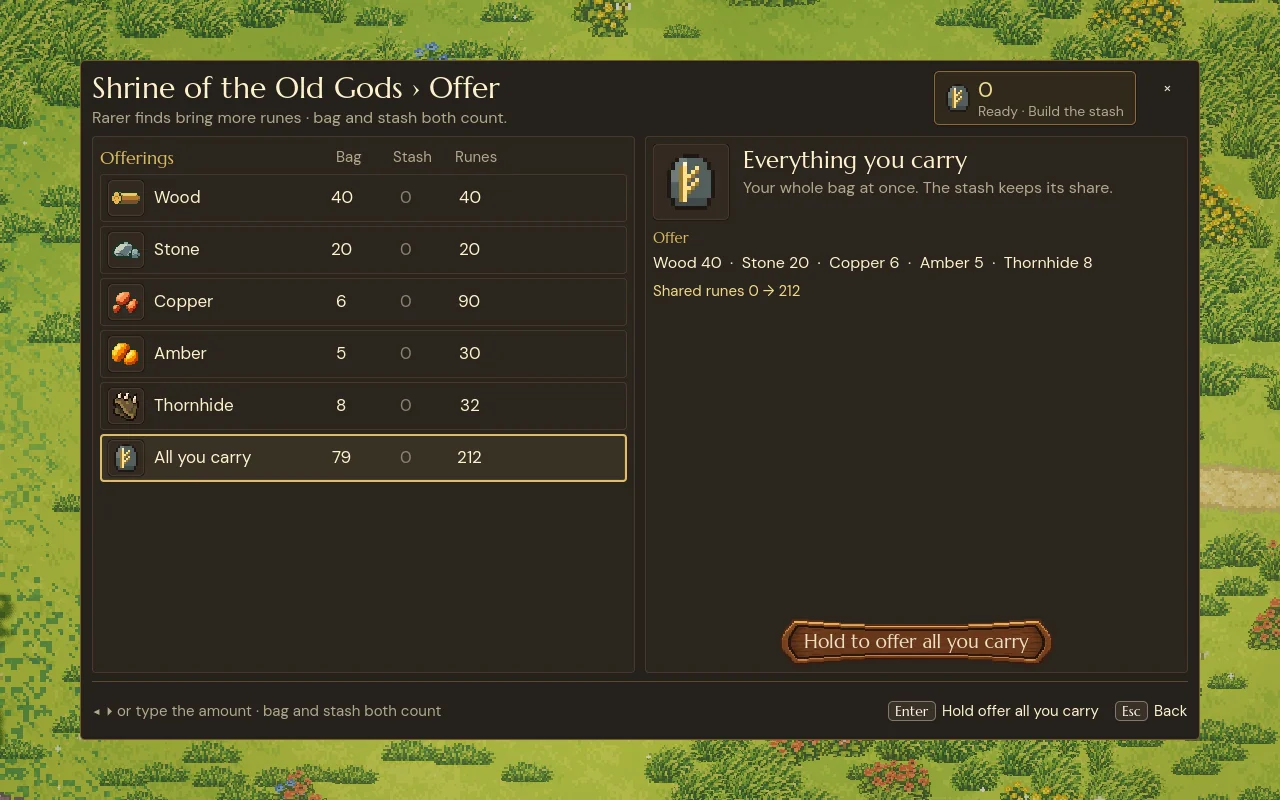
With one currency, any price can be read as "worth so many runes", and any source of income, a tree, an ore vein, a creature, as "so many runes a second".
Set the curve before the prices
The first decision is how steeply the game should climb, before any price is set. In Mytheria an ordinary enemy's health follows 1, 3, 8, 20 and 50 times the first region's, while its damage climbs more gently, 1, 2, 4, 8 and 16. Damage at the full 50 times would make every new region a two-hit death, a test of reflexes rather than a fair step up.
Then come the targets for how it should feel, written as ranges. Entering a region with the previous region's best gear, a typical enemy should take 3.5 to 8 seconds to defeat, and with the region's own new gear 1.2 to 3 seconds, so the upgrade is felt at once. The first region should take 3 to 5 in-game days, the second 5 to 7 and the later ones 6 to 9. Hunting should be 30 to 55 % of the work, so fighting matters while gathering stays the main activity.
Let the model set the prices
The model knows the game's own formulas: weapon damage, creature health, how many hits a rock takes, how long a walk between trees is, what refills at dawn. From those it works out what a player earns in a day in each region, and what the region asks them to buy: gear, upgrades, stations and restoring its settlement.
The prices are generated from rules like "a region's new weapon and tools cost about a day of that region's income" and written into the game's data. In the model today, a new region's weapon and tools cost between 0.88 and 0.92 of a day's income there. When something changes, like a new region or a new source of income, we generate the prices again and every price moves with it.
This is the result, with every curve shown relative to the first region on a scale where each step doubles:
Switch the view, then turn curves on and off
Because income and spending climb together, the number of days in each region stays steady even though the prices grow fiftyfold. That steady number of days is what we aim for, and the prices are set to produce it.
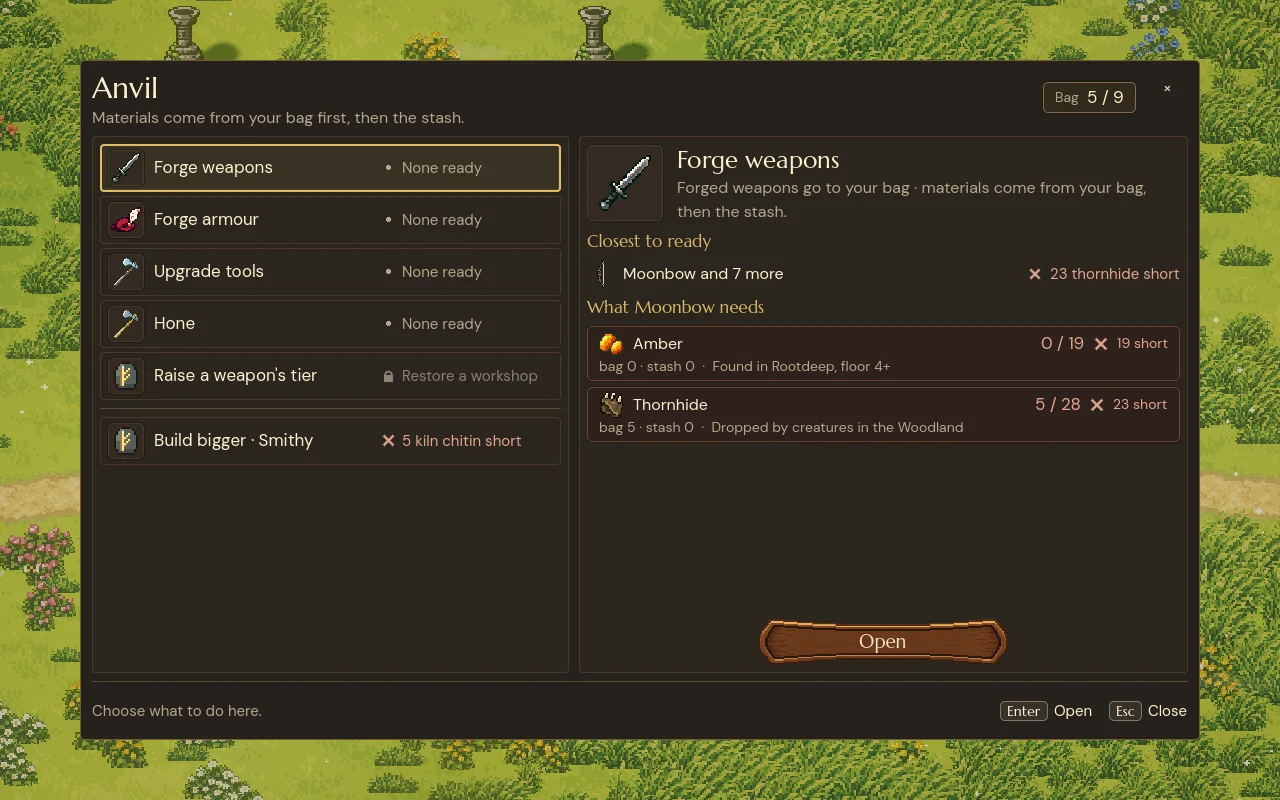
Armor follows the same thinking: honing a set up a grade costs about what forging a new one would, so players keep the set they like; see armor sets that stay useful.
Check every target, every region
The model ends with a table: every target, every region, pass or fail. Today 104 of 108 checks pass. The four that miss are all about how long you can stand at the edge of a danger zone when the fog is out, so we know exactly where to look next. A whole playthrough comes to about 33 in-game days alone, or about 26 when two play together.
Check the model against play
A model is only a guess until it's checked, so we play with real input and measure the same things the model predicts. Fight lengths came out at 0.86 to 0.97 of the model's figures. In Copper Bloom we earned 2,178 and 2,380 runes' worth a day on two runs, against the model's 2,413. That's close enough to trust it, and where play and model disagree, we fix the model as well as the price.
The same thinking sets the weapons themselves; how their damage is balanced is in how to balance weapons with a damage budget. And where all this spending fits in the bigger rhythm of the game is in game loop design.
A checklist for game economy design
- Give every resource a value in one currency.
- Set the difficulty curve before any price.
- Write targets as ranges: time per region, kill times, how much is fighting.
- Model income and spending with the game's own formulas.
- Generate prices from rules instead of typing them in.
- Check every target in every region, and keep the misses visible.
- Play, measure, and fix the model where it's wrong.
Further reading
- Game loop design: gather by day, survive the nightMytheria's core gameplay loop as a real example: a daily loop of gathering and night danger inside a region loop of settlements, upgrades and bosses.
- How to balance weapons with a damage budgetHow we balance Mytheria's nine weapons: a damage budget per tier, every move costed in seconds of budget, with all 108 combinations measured in play.
- MytheriaEarn, spend and grow stronger yourself: a pixel-art co-op adventure for one to four players.
Wishlist Mytheria
Mytheria is a pixel-art co-op adventure for one to four players, coming to Steam for Windows, macOS and Steam Deck. A wishlist is the best way to follow it and to help us.