Monster camps and danger zones in an open world
How Mytheria places enemies in its open world: camps that fight as a group and come back at dawn, wanderers on roads, and danger zones you can't cheese.
On this page
When enemies are scattered evenly across an open world, every walk is the same: a creature every few seconds, one at a time, with no place they belong to. In Mytheria, our pixel-art co-op game, most creatures live in camps you can find, mark and clear. A few wander the roads, and a handful of places are so dangerous that stepping in is a decision.
How should enemies be placed in an open world?
Group them into places with a purpose instead of spreading them out. A camp is a small group in a fixed spot that fights together and rewards you for clearing it, and wanderers on routes keep the roads busy between camps. Rare danger zones are much stronger and clearly marked, so they become goals for later. Each kind should look different from far away, so the player can choose their fights.
The short answer
How Mytheria places its creatures:
- There are 36 camps of 5 to 7 creatures, each with a leader, a den and a cache.
- When one member is alarmed, the whole camp reacts.
- Camps come back at dawn in the same spot, and drop their cache once a day.
- 24 wanderers walk set routes between them.
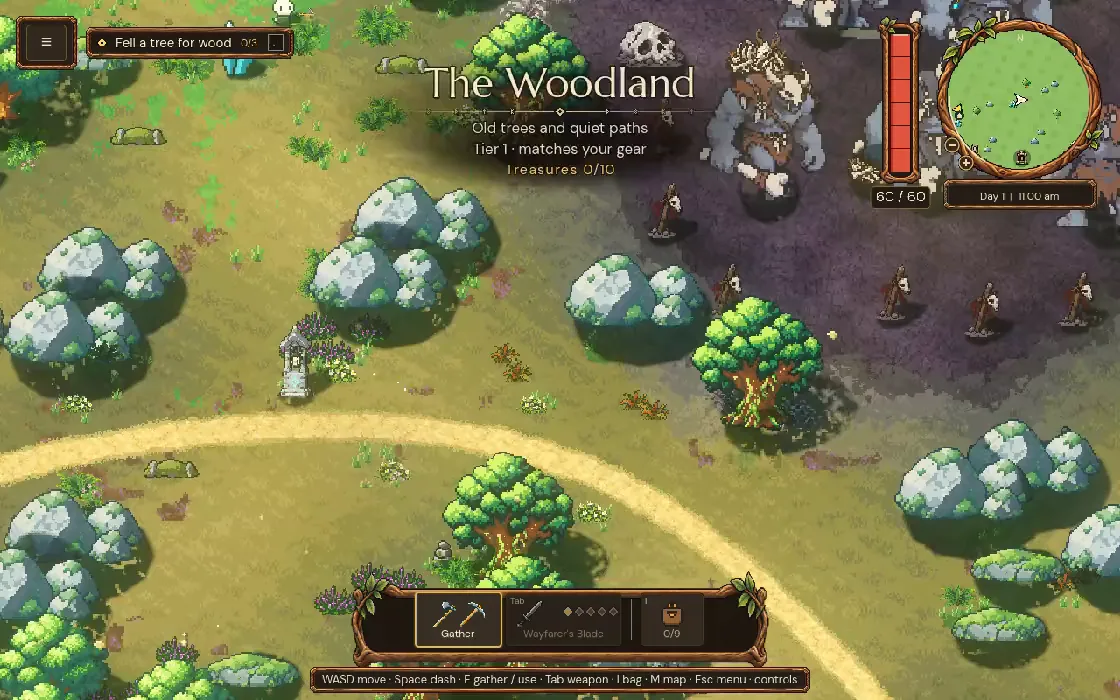
- 7 danger zones have dark ground, warning props, and creatures with three times the health and twice the damage of their region.
- Strike a zone's creature from outside and the horde chases you and fires back.
- Camps and zones never move, even when the rest of the island reshuffles.
Give every creature a home
A camp is a leader, a den and a ring of followers around a fixed heart. There are four kinds: nests, packs, herds that flee together, and fire camps; five of them only come out at night. The Thornling Fire Camp, for example, is a Thornling Chief, four thornlings and a sporecaster around a fire pit. The chief has four times a thornling's health and hits half again as hard.
The leader walks a slow patrol around the camp, a quarter of its ring every 11 seconds, and the followers stroll nearby. That small movement makes a camp look like a living group from the edge of the screen, before it has noticed you.
Make a camp fight as one
When one member notices you, the whole camp is alarmed. Followers close to about 78 units and wait for the leader to strike first, then join a moment later, one after another, so the fight builds instead of landing all at once. A ranged member can still fire from the back:
Clear the camp and it drops a small cache of materials at its heart, once a day. Fallen members don't respawn on a timer; they all stand up again at dawn, each in its own seat, so a camp is a place you come back to.
Put a few wanderers on the roads
Camps alone would leave the roads empty, so 24 single creatures walk set routes between them, like a hollowhorn crossing the Woodland road. They keep the ordinary respawn and make the space between camps feel lived in, without turning every road into a fight.
Make danger zones a decision
A danger zone is a place you see long before you should enter it. The ground turns dark and cracked, warning props stand at its edge, the music sinks almost to silence, and its name appears in red as you cross in. Its creatures are a real step up: three times the health and twice the damage of everything around them. In the clip at the top of this post, one giant's blow takes half the player's health.
They're dangerous but fair: every giant can notice you anywhere inside, and each rears up for 0.7 seconds before its first blow, so you see it coming. How we make warnings like that readable is in telegraphing attacks.
Don't let players shoot in from outside
A zone that only reacts to players inside it invites one trick: stand outside and shoot in. So a struck creature provokes its horde: they chase their attacker up to 220 units past the edge for eight seconds, and fire back with bursts that reach 480 units, farther than any shot you can make. Once they stop hunting and nobody has hit them for six seconds, they heal. Try it below:
Drag the player; then try shooting from outside the zone
Keep camps fixed
The daily reshuffle moves trees, rocks and creature dens every dawn, but never camps or danger zones. Players mark camps on the map, plan routes around zones and come back to finish a fight; that only works if they stay put. How the rest of the world spreads out between them is in how to make a game world bigger without making it empty.
A checklist for open-world creatures
- Group creatures into camps with a leader and a home.
- Let one alarm wake the whole camp.
- Let a camp fight build up gradually.
- Reward a cleared camp, once a day.
- Bring camps back at dawn, in the same places.
- Put wanderers on the roads between camps.
- Mark danger zones clearly, from far away.
- Make zone creatures much stronger, but warn before every blow.
- Punish shooting in from outside.
- Never move what players plan around.
Further reading
- Telegraphing attacks: how to warn players before a hitA telegraphed attack warns you where and when it will land. How Mytheria telegraphs every attack: a shape on the ground, a clock, more time for big hits.
- How to make a game world bigger without making it emptyHow Mytheria's island grew five times wider without feeling empty: named places, huge landmarks, roads, and something to find every few seconds.
- MytheriaFind the camps and dare the danger zones: a pixel-art co-op adventure for one to four players.
Wishlist Mytheria
Mytheria is a pixel-art co-op adventure for one to four players, coming to Steam for Windows, macOS and Steam Deck. A wishlist is the best way to follow it and to help us.