Game sound effects: why sound is half of a good hit
How Mytheria layers its game sound effects: a hit is four or five sounds triggered by the fight itself. Hear one real fight with and without the layers.
On this page
Play a fight with the sound off and it falls flat, however good the animation is. Sound tells you a blow landed before your eyes have caught up, and how heavy it was. In Mytheria, our pixel-art co-op game, a single hit is several layered sounds, and each one is triggered by something that really happened in the fight.
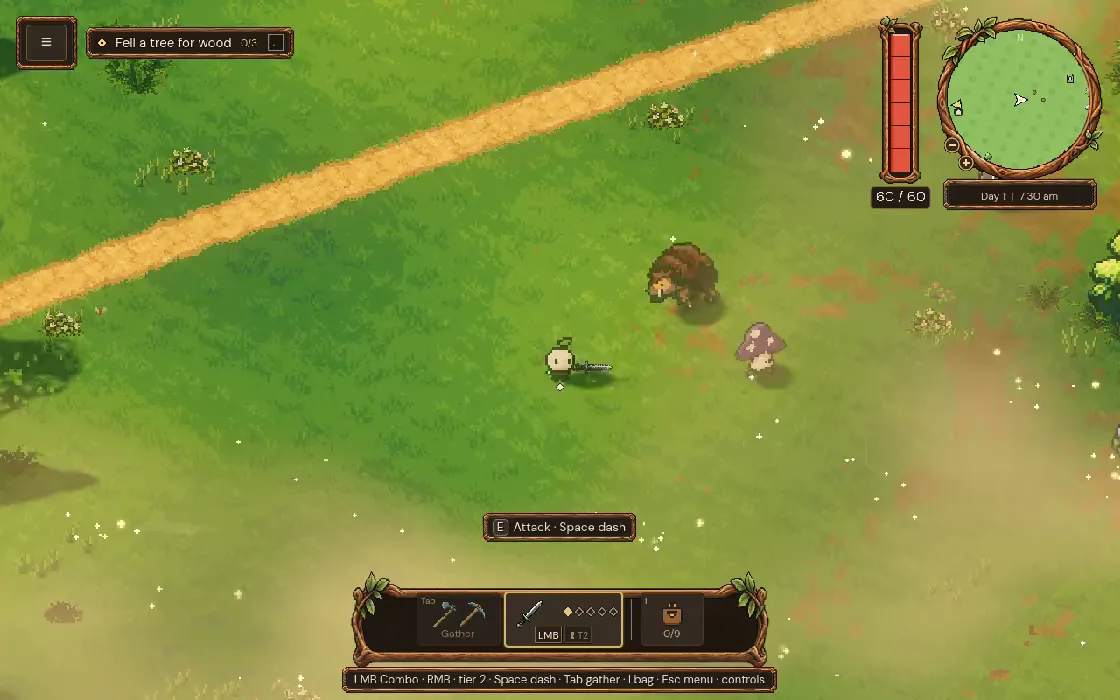
The fight below was filmed in the game for this post, and its sound was rendered through the game's own mixer from that fight's events.
How do you make hit sound effects feel good?
Build each hit from layers. A satisfying hit is several short sounds at once: the swing through the air, the contact on the target, and accents about the moment, like a rising note as a combo builds. Trigger each layer from the game's own events so sound and picture match exactly, vary the samples so repeats don't grate, and make sure the most important sounds are never cut off.
The short answer
How Mytheria's hits sound:
- Every hit layers the swing, the creature's own hit sound and the weapon's contact sound.
- A lower whoosh plays under lunging swings, a rising note on the second and third hit of a combo, and a heavy burst when the combo finishes.
- Nothing plays for a hit the game didn't count.
- Variants play in a shuffled order, so the same sample never plays twice in a row.
- 4 of the 24 voices are kept for important sounds.
- Nearby sounds play at full volume, and far ones fade and pan.
Hear the layers
Turn your sound on and play the fight. Then switch the extra layers off and play it again: the swings and hits stay, but the whoosh under each lunge, the rising combo and the finishing burst are gone. The timeline under the clip shows what triggered each layer, and the waveform shows the mix:
Turn your sound on, play, then switch the layers off and on
The fight and the picture are identical in both, and the fight still feels different.
Build a hit from parts
The swing is a short whoosh as the weapon moves, so even a miss sounds like an attack. When the attack carries you forward, a lower, quieter whoosh plays under it, so the step sounds like it has weight. Every creature has its own hit sound, so a fleshy creature thuds and a shelled one clacks. Heavier weapons add their own impact on top, so the same creature sounds different under a maul than under twin sickles.
Each layer is short and fairly quiet on its own, and together they sound like one big hit.
Let the combo climb
A combo should sound like it's going somewhere. The second hit of a combo adds a strike pitched up three semitones, the third one seven, so the sequence rises like a short melody. When the combo finishes, a heavy metal burst, pitched down two semitones, lands on top. In the fight above that happens once, at the end of the first combo. How the combo looks and feels is covered in how to make combat feel good.
Trigger sound from what really happened
In co-op, the host's game decides what hits. Mytheria plays a hit sound only when the game confirms the hit, so a sound always means something landed. It also means the sound and the flash, the shake and the damage number all come from the same event and line up exactly.
A busy hit can touch several targets at once. The weapon's contact layer plays once per player and weapon per frame, so a sweep through five creatures sounds like one big blow.
Keep repeats from grating
A fight repeats the same sounds dozens of times; in the 12 seconds above, the swing plays 36 times. Each sound has a few recordings, played in a shuffled order that never repeats the last one. The same sound can't restart within about a twentieth of a second, so a pile of hits doesn't turn into a buzz. The extra layers also sit well below the main hit, with the lunge whoosh and the combo steps at about a third of the creature's hit.
The same rules, pushed further, keep the most played sound in the game pleasant: see a pickup sound you can hear a thousand times.
Keep the important sounds audible
Big fights can trigger more sounds than the game can play at once. Mytheria plays at most 24 sounds at a time, and the last 4 are kept for important ones: hits, getting hurt, the combo finish. In a crowded moment a swing sound can be skipped, but the sound that tells you you've been hit always plays.
A sound within 60 units of you plays at full volume, fades to silence at 520, and is panned left or right by where it happened, so in co-op you can tell your friend's fight from your own. Every weapon has its own contact sound; the weapons themselves are in weapons that each feel different.
The music steps aside in a fight too, so these hits come through; see game music that leaves room for silence.
A checklist for hit sound effects
- Build each hit from several short layers.
- Give each layer its own job.
- Make the combo rise and the finish land heavier.
- Trigger sounds only from confirmed events.
- Play the contact sound once per blow, however many targets it hits.
- Shuffle variants and never repeat the last one.
- Keep voices free for the sounds that matter most.
- Fade and pan sounds by distance.
Further reading
- How to make combat feel goodHow we made combat feel good in our indie game Mytheria: hitstop, hit flash, knockback and screen shake, with real frame data you can try yourself.
- How to design weapons that each feel differentHow we designed Mytheria's nine weapons around one verb each, from a harpoon that pulls to runes you set off later. See every weapon in play.
- MytheriaHear it for yourself: a pixel-art co-op adventure for one to four players.
Wishlist Mytheria
Mytheria is a pixel-art co-op adventure for one to four players, coming to Steam for Windows, macOS and Steam Deck. A wishlist is the best way to follow it and to help us.