Hue shifting
Hue shifting changes the hue along a colour ramp, so highlights lean warm and shadows lean cool, in place of only making one colour lighter and darker.
Also called hue-shifted ramps, hue shift shading.
A colour ramp is the set of shades a material uses, from its brightest to its darkest. In a hue-shifted ramp the colour itself turns as it darkens: lit surfaces lean towards warm yellow and orange, and shaded ones towards cool blue and purple. It's how pixel art suggests a light source, because sunlight is warm and the shade is lit by a cool sky.
Why not just darken the colour?
A ramp that only gets darker, or that falls to grey, makes pixel art look muddy. The darkest part of a sprite is often most of its pixels, a forest's leaves for example, and grey shade drains the colour exactly there. Coloured shade keeps the form readable and the scene alive.
Hue shifting in Mytheria
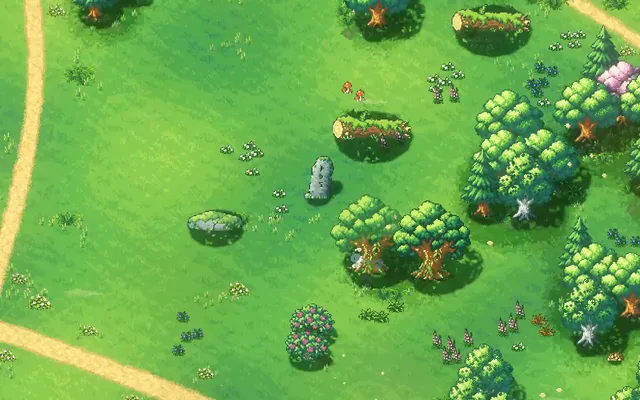
Our tree leaves use nine greens. The lightest is a warm yellow-green and each step down turns cooler, ending in a deep teal: measured as a hue, a shift from 69 degrees to 181. Rocks do the same with grey, from a warm, slightly yellow grey on lit faces to a cool blue-grey in shade. Outlines are a dark colour from the sprite's own family, never black, and earth and wood stay warm so paths stand out against the greens.
 The full post, with clips and demos Pixel art color palette: how we fixed a washed-out forest