Environmental storytelling
Environmental storytelling tells a game's story through the world itself, with places, objects and short texts players find while they play.
Also called world storytelling, storytelling without cutscenes.
Cutscenes stop the game to tell the story. Environmental storytelling puts the story where players already go, in pieces small enough to take in without stopping: a ruin, a name, a line carved on a stone. The full picture forms slowly, in whatever order the player finds the pieces.
What makes it work?
Each piece should stand alone, so any order works, and the game should still be complete for a player who reads nothing. In a co-op game it matters even more, because a cutscene makes one player watch while the other wants to keep playing.
Environmental storytelling in Mytheria
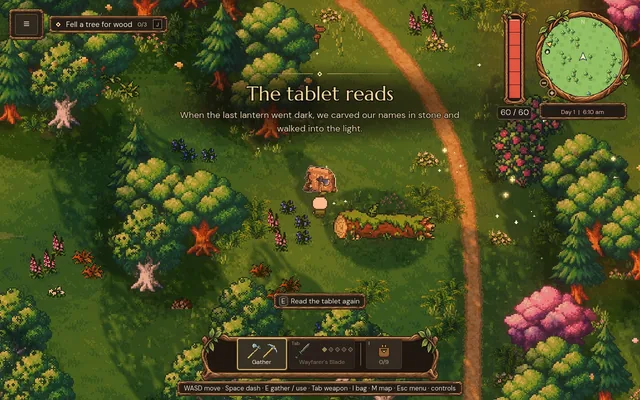
The story never stops play. There are 16 rune tablets, three or four per region, each holding exactly one sentence. Places show their name and a short line as you walk in, each boss has a title card that hints at who it used to be, a fallen keeper leaves one line about the people it guarded, and the next dawn adds one more. In co-op, a tablet anyone reads goes into one shared lore log, in the order it was found.
 The full post, with clips and demos How to tell a story without cutscenes